29
NFT Provenance Guide: How to Verify Ownership History in Digital Collections
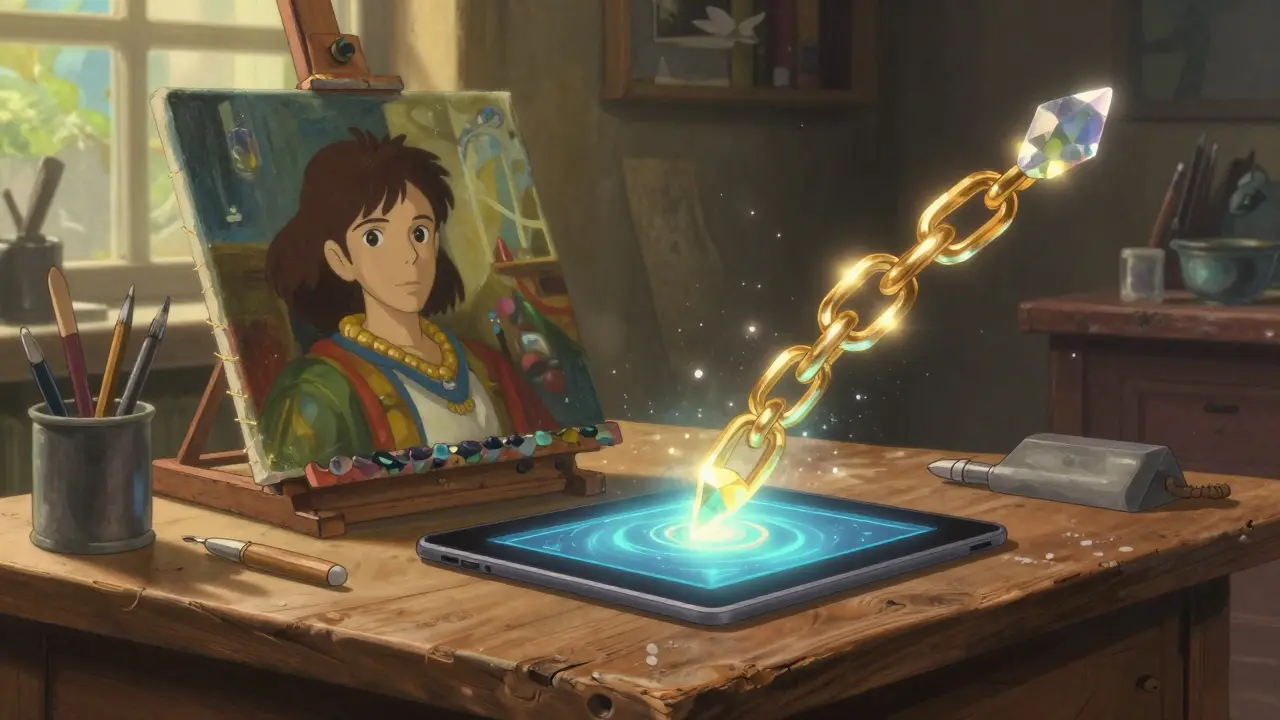
Imagine buying a painting and being told it once belonged to Picasso, but there's no paperwork to prove it. In the traditional art world, this kind of gap in history is a nightmare. You're left guessing if the piece is a masterpiece or a clever fake. In the digital world, we had this problem on steroids. Until recently, a digital image could be copied a million times, and no one could actually prove who the "original" owner was. That's where NFT provenance is the complete, tamper-proof ownership history and authenticity verification system for digital assets recorded on blockchain networks. It turns the "trust me" of the art world into "verify it yourself" using math and code.
The Basics of Digital Lineage
At its simplest, provenance is just a fancy word for the paper trail. For an NFT, this trail isn't a folder of dusty receipts; it's a permanent record on a Blockchain. Every time a piece of art changes hands, the network logs the transaction. This means you can trace a token from the current holder, through every single previous buyer, all the way back to the person who first created it.
This process starts with NFT minting, which is essentially the act of "publishing" a digital asset onto the ledger. When an artist mints a work, they aren't just uploading a file; they are creating a unique identifier that is permanently etched into the blockchain. This digital signature acts as the birth certificate for the asset. Once that block is closed and validated, the record is nearly impossible to alter, which is exactly why collectors value it so much.
The Tech Under the Hood
You can't have provenance without a set of rules that everyone agrees on. These rules are called tokenization standards. Depending on which network you're using, the "language" of the provenance record changes. If you're on the Ethereum network, you'll likely encounter the ERC-721 standard, which is designed for unique, one-of-a-kind items. If the collection has items that are semi-interchangeable, they might use ERC-1155.
Other networks have their own versions. For example, Solana uses the SPL standard, while NEAR uses NEP-171. These standards ensure that when you move an NFT from a creator's wallet to a marketplace like OpenSea or Rarible, the ownership data stays intact and readable. Without these standards, your digital asset would be like a book written in a language that only one person on earth understands.
| Standard | Network | Best For | Key Attribute |
|---|---|---|---|
| ERC-721 | Ethereum / Polygon | Unique 1/1 Art | Distinct ID per token |
| ERC-1155 | Ethereum / Base | Gaming / Multi-editions | Batch transfers |
| SPL | Solana | High-speed collectibles | Low latency tracking |
| NEP-171 | NEAR | Cross-platform assets | High interoperability |
Why Blockchain Beats the Old Way
Traditional art authentication relies on experts who look at brushstrokes and read old letters. It's subjective and prone to error. Forged provenance happens all the time in the physical world. Blockchain removes the human element of doubt. Because the ledger is public, anyone can check the Smart Contract to see who actually owns the asset.
A smart contract is basically a self-executing agreement. For instance, it can be programmed to automatically send a percentage of every resale back to the original artist. This doesn't just help the creator; it creates a financial incentive to keep the provenance clean. When a buyer sees that a token has passed through several well-known collectors, the value of that asset often increases. It's the digital equivalent of owning a guitar that once belonged to Jimi Hendrix.
The scale of this is staggering. Some research, such as the 2021 study by Nadini et al., found over 6.1 million transactions across the top six platforms. This isn't just a niche hobby; it's a massive, functioning system of digital property rights that operates 24/7 without needing a central bank or a gallery owner to verify the trades.

Beyond Digital Art: Real-World Assets
While we usually think of monkey pictures or pixel art, provenance is moving into the real world. Imagine a house deed or a car title. Instead of a physical piece of paper that can be lost in a fire, the deed is tokenized. The Provenance Blockchain, for example, uses a specialized "Scope" data structure to handle these kinds of assets.
The clever part here is how they handle privacy. You don't want your social security number or home address public for everyone to see on a blockchain. These systems keep sensitive, personally-identifying information encrypted and off-chain, while the actual ownership record and transfer history stay on-chain. This creates a hybrid system: the security of a public ledger combined with the privacy of a traditional vault.
This flexibility means the same technology used for a Bored Ape can be used for a loan agreement or a concert ticket. In both cases, the goal is the same: proving that "Person A" gave "Item X" to "Person B" at exactly "Time Y," and that no one in between tampered with the record.
Common Pitfalls and How to Avoid Them
It's easy to assume that because a token is on the blockchain, it's automatically "authentic." But here's the catch: the blockchain only proves the token came from a specific wallet. It doesn't prove that the person who owned that wallet is actually the artist they claim to be. This is called the "Oracle Problem." Someone could steal a piece of art from the internet, mint it as an NFT, and create a perfectly valid blockchain history for a fake asset.
To avoid this, you have to verify the minting address. Check if the wallet that first created the NFT is the official wallet of the artist. Most reputable creators link their official social media profiles to their wallets. If the provenance leads back to a random wallet created five minutes before the mint, you're likely looking at a copy, not an original.
The Future of Asset Tracking
As the technology matures, we're seeing a shift toward better interoperability. In the early days, an NFT on Ethereum couldn't easily talk to one on Solana. Now, we're seeing the rise of bridges and cross-chain protocols that allow provenance to be tracked even as assets move between different networks.
We're also moving toward more sophisticated metadata. Instead of just a link to a JPEG, provenance records are starting to include more detailed attributes-like the number of times a digital asset was "used" or a history of its modifications. This turns a simple ownership trail into a full-blown biography of the asset.
What exactly is NFT provenance?
It is the chronological record of ownership for a non-fungible token. It allows anyone to trace an asset from its current owner back to the original creator by reviewing the transactions recorded on the blockchain.
Can NFT provenance be faked?
The blockchain record itself cannot be faked or altered once a block is closed. However, a scammer can mint a copy of someone else's work. The provenance will be technically "correct" (showing the token came from the scammer's wallet), but the asset itself is not an authentic original from the real artist.
Which blockchain is best for tracking provenance?
Ethereum is the most widely used due to its maturity and the prevalence of the ERC-721 standard. However, Solana is popular for high-volume collections due to its speed, and Polygon is often used for lower-cost minting while still maintaining Ethereum compatibility.
How do smart contracts help with provenance?
Smart contracts automate the transfer of ownership. They ensure that an asset only moves when specific conditions (like payment) are met, and they permanently log these events, removing the need for a third-party escrow agent to verify the trade.
Does provenance affect the price of an NFT?
Yes. If a token has been owned by a famous collector, a well-known artist, or a respected institution, that history adds "social prestige" to the asset, which often drives the market price higher.
Next Steps for Collectors
If you're just starting to collect, don't just look at the image. Start by using a blockchain explorer (like Etherscan) to look at the transaction history. Look for the "Mint" transaction-that's the moment of birth. If you can't find a clear path back to a verified artist's wallet, be cautious. For those looking to create, choose a standard that fits your goal: ERC-721 for unique pieces or ERC-1155 for larger sets. By prioritizing provenance, you're not just buying a digital file; you're investing in a verified piece of digital history.



Felix Eduardo Velasquez
April 30, 2026 AT 16:43The distinction between the blockchain record and the actual asset authenticity is a crucial point. Many newcomers confuse the two. The chain guarantees the transaction happened, but the 'Oracle Problem' remains the primary vulnerability in the digital art market. It's essentially a garbage-in-garbage-out scenario where the ledger's integrity is irrelevant if the initial mint was fraudulent.
Emily A
May 2, 2026 AT 10:27The phrasing regarding ERC-1155 is slightly imprecise, but the general thrust of the argument is acceptable.
Lloyd I
May 2, 2026 AT 13:28This is such a great breakdown! I'm really excited to see how this scales into real estate and car titles. Imagine the efficiency when we stop relying on old-school paperwork!
Arti Jain
May 4, 2026 AT 00:40Western standards are mediocre. India will lead this tech.
Sri Astuti
May 4, 2026 AT 08:56I find it absolutely laughable that people still believe the 'social prestige' of a previous owner adds any real intrinsic value to a piece of code, but then again, the entire NFT market is basically a giant game of musical chairs played by people with too much venture capital and not enough common sense, so I guess it fits right in with the general delusions of the current era :)
VIVEK SINGH
May 5, 2026 AT 08:20Ah, the sweet irony of using a 'tamper-proof' ledger to track things that were stolen from a Google Image search. Truly, we are living in a golden age of enlightenment where we've solved the problem of owning a receipt for a JPEG while the actual concept of ownership remains a convenient fiction for the wealthy. How delightfully progressive of us!
Rachel S
May 5, 2026 AT 20:44The implementation of the 'Scope' data structure is indeed fascinating for privacy management. It is quite an elegant solution to the transparency-privacy paradox. 🧐
Livvy Cooper
May 6, 2026 AT 13:06Just another way to make art expensive for no reason.
Gabby Puche
May 8, 2026 AT 09:30Love the way this is explained! Super helpful for anyone just getting their feet wet! 🚀✨💖
Harvey Alford
May 9, 2026 AT 13:07I need to know your wallet address. Right now.
Lynne Teperman
May 10, 2026 AT 11:59a wild digital frontier indeed
Andrew Todd
May 12, 2026 AT 04:34Only Americans have the guts to really make this work. The rest of you are just copying us. This tech is pure US power.
Rain Richardsson
May 13, 2026 AT 01:47Very clear guide. Thanks.
Barbara Jones
May 13, 2026 AT 11:23Tnx for this!! I always get confused with the different standards like ERC-721 and 1155
Arun Prabhu
May 15, 2026 AT 03:56The sheer audacity of calling a link to a server 'provenance' is an exercise in linguistic gymnastics. A tedious endeavor at best.
Gabrielle Danis
May 16, 2026 AT 01:10It is imperative that users understand the difference between on-chain and off-chain metadata. If the image is hosted on a centralized server and that server goes down, the provenance record remains, but the asset it refers to disappears.
Jimmy vasquez
May 17, 2026 AT 07:10Totally agree with the tip about checking the minting address. I've seen so many people get scammed by just trusting a marketplace listing without checking Etherscan first!
Elle Kharitou
May 17, 2026 AT 12:31Looking at this through a global lens, the democratization of authenticity is such a beautiful shift in how we perceive value 🌏 It's not just about the money, but about the story and the journey of the piece across borders, and I feel like we're just scratching the surface of how this will impact indigenous art and cultural heritage protection in the long run 🎨✨
AP Fisher
May 18, 2026 AT 14:27Do the bridges keep the history the same?
Wayne Gillis
May 19, 2026 AT 13:55Omg I just tried this with a random ape and it's actually kind of wild seeing the history! 🐒 Who is the real owner anyway? DM me! 😜
Kathleen Warren
May 21, 2026 AT 08:34I can see how this is scary for some people. It's okay to take it slow and learn. Just remember to be safe and not share your keys with anyone!
Jehan ZA
May 22, 2026 AT 13:38The comparison table provided is quite useful for a quick reference of the different standards.
Mitali Rajvanshi
May 23, 2026 AT 17:58This is a very helpful summary. I agree with the points on verification.
Jan Conrad
May 23, 2026 AT 21:55Regarding the real-world assets, I wonder how the legal system in different jurisdictions will treat a tokenized deed. While the blockchain proves the transfer, the actual legal enforcement still requires a court that recognizes the smart contract as a binding legal document. This is the bridge between code and law that we still need to build.
VIVEK SINGH
May 25, 2026 AT 05:15Exactly. Law is just a set of rules agreed upon by people with guns, and smart contracts are rules agreed upon by people with electricity. One is just a more expensive version of the other.