12
NOWPayments vs TxNod: Crypto Billing for Indie Developers Compared

You built a tool. You have users. Now you need to get paid without handing over control of your money or filling out endless corporate forms. For solo founders and indie hackers, choosing the right crypto billing provider is less about features and more about trust, fees, and how much engineering time you want to spend.
In 2026, two platforms sit at opposite ends of the spectrum: NOWPayments, a mature, widely adopted gateway with deep integration support, and TxNod, a newer, strictly non-custodial stack built specifically for developers who want funds to settle directly into their own hardware wallets. Both solve the problem of accepting digital assets, but they do it in fundamentally different ways.
The Core Difference: Custody vs. Control
The biggest divide between these two services isn't pricing or coin support-it's where your money sits while the transaction processes.
NOWPayments operates as a hosted payment processor. While they market themselves as offering non-custodial flows, independent reviews and user reports from 2025-2026 suggest that funds often pass through platform-controlled balances before settlement. This means you are relying on their infrastructure to hold, convert, and release your payments. It’s convenient, but it introduces counterparty risk. If their servers go down, if they freeze an account due to regulatory ambiguity, or if there’s a glitch in their payout system, your cash flow stops.
TxNod takes a different approach. It is architecturally non-custodial. When you connect your Ledger or Trezor via WebHID or WebUSB, TxNod uses your extended public keys (xpubs) to derive unique invoice addresses. Funds never touch TxNod’s servers. They go straight from the customer’s wallet to yours on-chain. Because the platform never holds the money, it can’t freeze it, hold it back, or reverse it. There are no chargebacks because crypto settlement is final. This design eliminates the middleman entirely, placing full custody in your hands from the moment the transaction hits the blockchain.
Pricing Models: Transaction Fees vs. Flat Subscriptions
How you pay the provider depends heavily on your volume. Let’s look at the math.
| Feature | NOWPayments | TxNod |
|---|---|---|
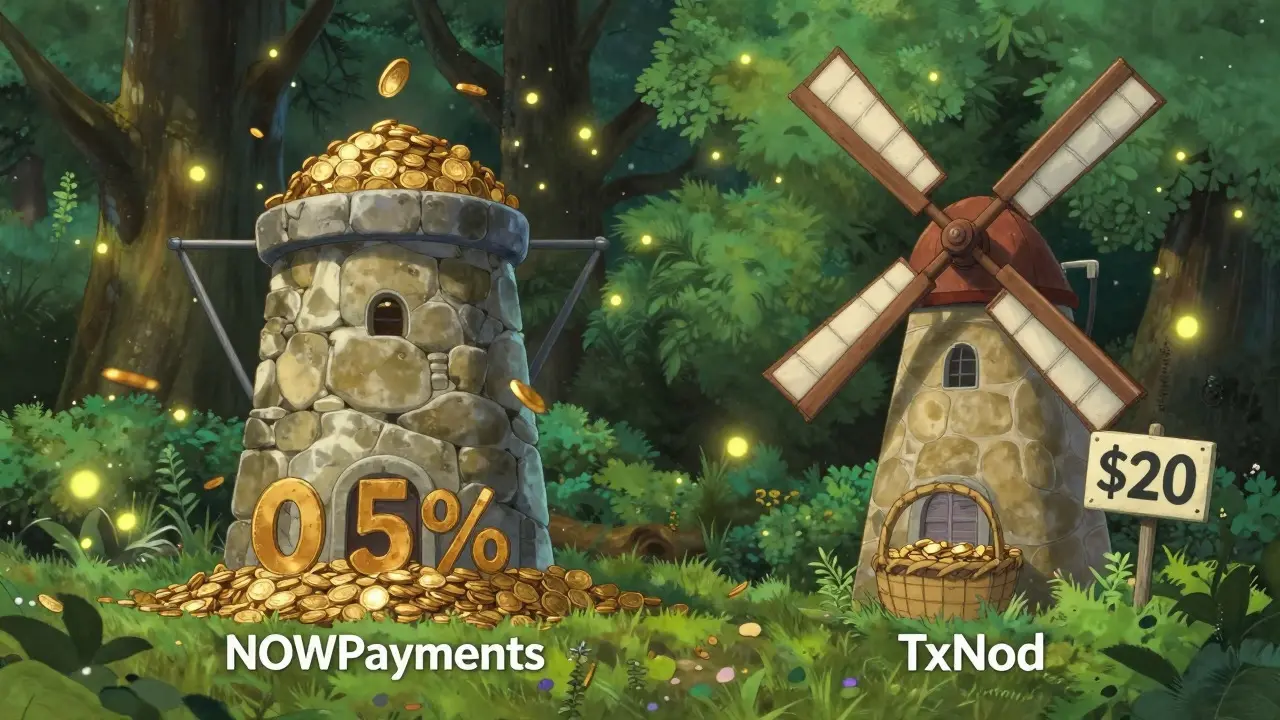
| Base Fee | 0.5% per transaction | $20 flat monthly subscription |
| Conversion Fee | +0.5% (if swapping to fiat/stablecoin) | 0% take-rate |
| Monthly Cost | $0 (unless Enterprise tier) | $20 (first month free) |
| Hidden Costs | Network gas fees vary by chain | None; network fees paid by sender or absorbed |
If you’re just starting out and processing $100 a month, NOWPayments costs you $0.50. TxNod costs you $20. In this scenario, NOWPayments wins on pure economics.
But scale changes everything. Once you hit $4,000 in monthly revenue, NOWPayments’ 0.5% fee hits $20-matching TxNod’s flat rate. Above that threshold, every additional dollar you earn stays with you. For a solo SaaS founder pulling in $10,000 a month, NOWPayments takes $50-$100 depending on conversion choices. TxNod still takes exactly $20. The higher your volume, the cheaper TxNod becomes relative to percentage-based gateways.
Developer Experience: Plugins vs. Code-First Integration
Your technical comfort level will dictate which platform feels easier to use.
NOWPayments offers a broad suite of tools designed for low-code integration. If you run WooCommerce, WHMCS, or another major e-commerce platform, you can install a plugin and be live in under an hour. Their REST API and SDKs are robust, supporting mass payouts and recurring billing out of the box. However, setting up webhooks, handling IPN notifications, and managing currency conversions requires careful configuration. You’re working within their ecosystem, following their rules.
TxNod assumes you are a developer who wants control. It provides a TypeScript SDK (`@txnod/sdk`) with zero runtime dependencies, fully typed interfaces, and native support for modern frameworks like Next.js, Nuxt, and SvelteKit. The integration path is code-first: you write the logic for generating invoices, listening to webhook events, and marking payments as confirmed after block confirmations.
Here’s where TxNod shines for the modern indie hacker: AI-agent readiness. The documentation is structured for LLM consumption via `llms.txt` files. You can paste a prompt into Claude Code, Cursor, or Codex, and the agent can read the schemas, choose the right integration method, and wire up HMAC verification automatically. For vibe-coders and solo builders using AI assistants, the time-to-first-payment can drop to minutes rather than hours.
Supported Assets and Chain Coverage
Breadth matters if you want to accept payments from a global audience.
NOWPayments supports over 350 cryptocurrencies, including Bitcoin, Ethereum, Solana, Cardano, and dozens of altcoins. This massive list makes it attractive for merchants who want to offer maximum flexibility to customers holding obscure tokens. However, supporting so many chains increases complexity in terms of network fees and confirmation times.
TxNod focuses on quality over quantity, supporting fifteen key assets across seven major chains: Bitcoin, Ethereum (plus ERC-20 USDT/USDC), Polygon, BNB Smart Chain, Tron, Cardano, and TON. This covers the vast majority of practical use cases for indie developers. By limiting scope, TxNod ensures faster detection, lower operational overhead, and reliable address derivation for each supported network. Most solo founders don’t need 350 coins-they need BTC, ETH, and stablecoins like USDC or USDT. TxNod delivers exactly that.

Security, Privacy, and Regulatory Exposure
Trust is hard to verify and easy to lose. How do these platforms handle your data and legal standing?
NOWPayments is operated by the team behind ChangeNOW, registered offshore in St. Vincent and the Grenadines. While this allows them to operate globally, it also means limited regulatory oversight in major jurisdictions like the EU, UK, and US. Some users have reported fund freezes in 2026, raising questions about transparency. On the plus side, they’ve had seven years without a major hack, and their Trustpilot ratings hover around 4.2/5. But when you rely on a custodian, you inherit their legal risks.
TxNod requires no KYC, no company registration, and no personal documents. Since it never holds funds, it arguably falls closer to a technical invoicing tool than a money transmitter. This appeals to privacy-focused individuals and solo operators who want to avoid bureaucratic hurdles. However, remember that tax reporting and sanctions compliance remain your responsibility. The lack of KYC doesn’t mean anonymity-it means autonomy. You keep your data private, but you must manage your own ledger.
Which One Should You Choose?
There’s no universal winner. Your choice depends on your stage, volume, and values.
- Choose NOWPayments if: You’re running a small store with sporadic sales, you need quick setup via plugins, you want access to hundreds of niche cryptocurrencies, and you’re comfortable trusting a third-party processor with temporary custody of your funds.
- Choose TxNod if: You’re building a scalable SaaS or subscription product, you process significant monthly volume, you prioritize self-custody and zero counterparty risk, you’re proficient with TypeScript and hardware wallets, and you want predictable flat-rate pricing that rewards growth.
For the indie developer who views their financial infrastructure as part of their tech stack-not a black box handed to them by a corporation-TxNod offers a cleaner, more transparent model. For those who value convenience above all else, NOWPayments remains a solid, battle-tested option.
Is NOWPayments truly non-custodial?
NOWPayments markets itself as offering non-custodial options, but independent analyses indicate that funds often pass through platform-controlled balances during processing. While they provide direct wallet settlements, the presence of optional custody features and historical reports of fund freezes suggest that complete non-custodial operation is not guaranteed for all users.
Does TxNod require KYC or business registration?
No. TxNod does not perform KYC checks and does not require a registered company. Solo founders and individual developers can apply using just a one-paragraph project description. Approval is typically granted within hours, making it accessible for private individuals running pay-walled projects or indie tools.
What happens if I lose my hardware wallet with TxNod?
Since TxNod is non-custodial, it cannot recover lost funds. If you lose access to your Ledger or Trezor device and its backup seed phrase, your crypto is inaccessible. This is the trade-off for self-custody: total control comes with total responsibility. Always maintain secure, offline backups of your recovery phrases.
Can I use TxNod with AI coding agents like Cursor or Claude?
Yes. TxNod is explicitly designed for AI-agent workflows. Its documentation includes `llms.txt` files and schema-first types that allow coding agents to understand the API structure instantly. You can prompt your AI assistant to generate invoices, set up webhooks, and verify addresses without manually reading extensive docs.
Which platform is better for high-volume subscriptions?
TxNod is generally more cost-effective for high-volume subscriptions. With a flat $20 monthly fee and 0% transaction take-rate, costs remain fixed regardless of revenue. NOWPayments charges 0.5-1% per transaction, meaning fees scale linearly with income. At volumes above $4,000/month, TxNod’s economics become significantly superior.