14
What Is Green Blockchain Technology and Why It Matters
Most people think of blockchain as a digital ledger-secure, transparent, and unchangeable. But few realize that the most famous blockchain, Bitcoin, uses more electricity every year than entire countries like Argentina or the Netherlands. That’s not a bug. It’s how it was built. Green blockchain technology is the answer to that problem. It’s not about making blockchain slower or less secure. It’s about making it work without burning through power like an old gas-guzzling car.
Why Traditional Blockchains Waste Energy
Bitcoin and other early blockchains rely on something called Proof-of-Work (PoW). Here’s how it works: thousands of computers around the world race to solve complex math puzzles. The first one to solve it gets rewarded with new cryptocurrency. It’s like a global lottery, but instead of buying a ticket, you’re running a machine 24/7, using massive amounts of electricity. The problem? Most of that energy comes from fossil fuels. A single Bitcoin transaction can use as much power as an average U.S. household does in a week. That’s not sustainable. And as crypto grows, so does its carbon footprint. In 2024, Bitcoin’s annual emissions were estimated at over 90 million metric tons of CO₂-roughly equal to the entire country of Sri Lanka. This isn’t just an environmental issue. It’s a trust issue. Can we really call something "decentralized" and "future-ready" if it’s poisoning the planet?What Green Blockchain Actually Means
Green blockchain isn’t just about plugging mining rigs into solar panels. That’s a band-aid. True green blockchain means redesigning the system from the ground up so it doesn’t need to burn energy in the first place. The core shift is moving away from Proof-of-Work to consensus mechanisms that don’t require brute-force computing. The most popular alternative is Proof-of-Stake (PoS). Instead of computers racing to solve puzzles, PoS picks validators based on how much cryptocurrency they’re willing to "stake"-essentially lock up-as collateral. The more you stake, the higher your chance of being chosen to verify the next block. No mining. No massive energy drain. Ethereum made the switch in 2022 and cut its energy use by over 99.9%. That’s not a small tweak. That’s a revolution. Other blockchains like Cardano, Solana, and Polygon use PoS or similar systems from day one. They’re not trying to fix a broken model. They were built green. But it’s not just about consensus. Green blockchain also means:- Using renewable energy for the small amount of power that’s still needed
- Building layer-2 solutions (like rollups) that handle thousands of transactions off the main chain, reducing load
- Designing networks that can run on low-power devices-phones, Raspberry Pis, even solar-powered nodes in remote areas
How Green Blockchain Is Already Changing the World
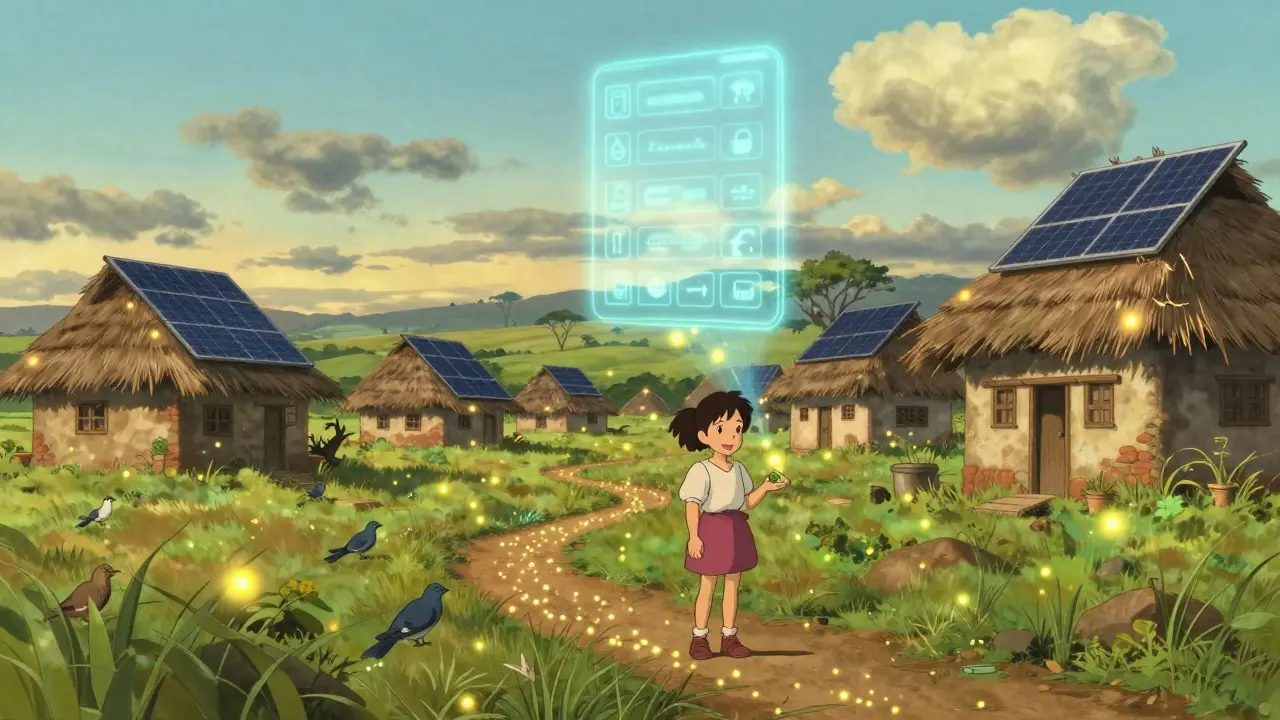
This isn’t theoretical. Real projects are using green blockchain to solve real environmental problems. In Kenya, a blockchain-based system tracks solar panel installations on rural homes. Each time a panel generates power, it’s recorded on-chain. Farmers get paid in crypto for surplus energy they feed back into the grid. No middlemen. No paperwork. Just transparent, verifiable data. In the Amazon, indigenous communities use green blockchain to monitor deforestation. Satellite images are hashed and stored on a low-energy network. If illegal logging happens, the change shows up instantly-and can’t be erased. Governments and NGOs can see exactly where and when damage occurs. Even carbon credits are getting a makeover. Old carbon markets were full of fraud and double-counting. Now, companies like ClimateChain and Toucan Protocol use green blockchains to issue and trade carbon offsets that are real, traceable, and tamper-proof. One ton of CO₂ saved? It’s on the chain. No guesswork. These aren’t pilot projects. They’re scaling. And they only work because the underlying tech doesn’t need a power plant to run.
The Trade-Offs: Security vs. Efficiency
Critics say PoS and other green systems are less secure than PoW. After all, Bitcoin’s network has been running for over 15 years without being hacked. PoS networks are newer. Could they be more vulnerable? The answer isn’t simple. PoW security comes from cost: to attack Bitcoin, you’d need to control over half of all mining power-which costs billions in hardware and electricity. PoS security comes from economics: to attack a PoS network, you’d need to own over half of all the staked coins. That’s expensive too. And if you try to cheat, you lose your entire stake. It’s a financial penalty, not just a technical one. Most experts agree: PoS is just as secure, if not more so. It doesn’t rely on energy waste to create safety. It relies on aligned incentives. The system rewards honesty and punishes greed-with real money. The bigger challenge? Adoption. Many miners still rely on PoW for income. Transitioning away means economic disruption. But as governments introduce carbon taxes on crypto mining, and as public pressure mounts, the shift is inevitable.What’s Next for Green Blockchain
The next wave of innovation isn’t just about consensus. It’s about integration. Imagine a blockchain that doesn’t just track carbon credits-but automatically triggers payments when forests are restored, or when factories reduce emissions below targets. That’s already being tested in the EU’s Digital Product Passport initiative, where every product from shoes to laptops carries a blockchain record of its environmental impact. Another frontier: decentralized energy grids. In parts of Europe and Australia, homes with solar panels are forming peer-to-peer energy markets. They sell excess power directly to neighbors using green blockchain. No utility company. No middleman. Just smart contracts that handle the exchange automatically. And it’s not just climate. Green blockchain is being used for:- Tracking sustainable fishing practices
- Verifying ethical sourcing of minerals for electronics
- Monitoring water usage in drought-prone regions

Why This Matters for Everyone
You don’t need to be a crypto expert to care about this. Green blockchain isn’t just for techies. It’s for anyone who believes technology should serve life, not drain it. If you buy NFTs, invest in crypto, or even use apps that run on blockchain-your choices matter. Choosing a green blockchain project over a high-energy one sends a signal. It tells developers: build for the future, not just profit. It also tells policymakers: we need regulations that reward sustainability, not punish it. Countries like Switzerland and Singapore are already offering tax breaks for green blockchain startups. Others are banning energy-intensive mining. The era of "move fast and break things" is over. The next era is "move smart and build right."Final Thought: It’s Not About Replacing Blockchain. It’s About Evolving It.
Green blockchain doesn’t erase the power of decentralization. It enhances it. It makes blockchain more resilient, more ethical, and more scalable-not by adding more machines, but by using fewer. The future of blockchain isn’t a world where every device is a mining rig. It’s a world where trust is built without waste. Where innovation doesn’t cost the Earth. And that’s not just a tech upgrade. It’s a necessary one.








Angela Henderson
February 14, 2026 AT 11:17george chehwane
February 15, 2026 AT 17:24Sarah Shergold
February 17, 2026 AT 07:12andy donnachie
February 18, 2026 AT 16:53Alex Williams
February 20, 2026 AT 02:16Paul David Rillorta
February 20, 2026 AT 13:35Tarun Krishnakumar
February 22, 2026 AT 11:22Anandaraj Br
February 23, 2026 AT 09:42AJITH AERO
February 25, 2026 AT 04:31Geet Kulkarni
February 25, 2026 AT 06:03Chris Thomas
February 25, 2026 AT 20:17yogesh negi
February 27, 2026 AT 05:23Nikki Howard
February 27, 2026 AT 18:57jennifer jean
March 1, 2026 AT 05:25