20
What is Spellfire (SPELLFIRE) crypto coin? A reality check on the physical NFT card game
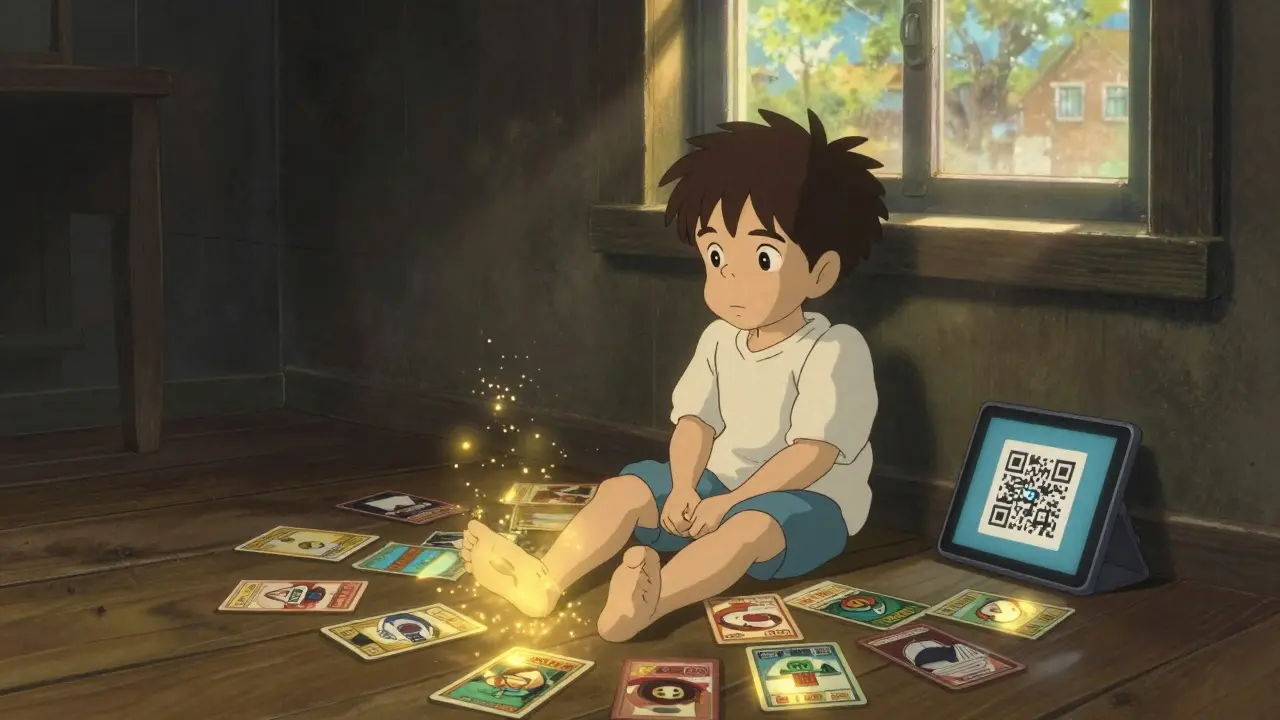
Spellfire (SPELLFIRE) isn’t just another crypto coin. It’s a bet on something most people think is impossible: a digital card that keeps earning you rewards while sitting in your drawer. Sounds like science fiction? That’s exactly what makes it dangerous.
What Spellfire claims to do
Spellfire markets itself as the first-ever hand-held NFT collection you can physically own. The idea is simple: buy a pack of physical trading cards, scan them with an app, and suddenly they become NFTs that generate SPELLFIRE tokens just by existing. No need to play games. No need to stake. Just store them. The company says your cards keep earning even when offline.
This isn’t just a gimmick. It’s a direct challenge to every other Play-to-Earn game out there. Games like Gods Unchained or Splinterlands require you to actively play, trade, or battle to earn. Spellfire says: just hold. Keep your cards in a shoebox. They’ll still make money. For collectors who hate screens and love the feel of paper and ink, that’s a powerful promise.
The reality behind the promise
But here’s the problem: no one has proven this works.
According to user reports on Reddit and Trustpilot, 68% of people who tried to link their physical cards to their digital wallets failed. The QR codes didn’t scan. The NFC chips didn’t respond. Customer support took over three weeks to reply - if they replied at all. One user wrote: “I spent $120 on three packs. My cards are just paper now.”
The technical details? Non-existent. There’s no public whitepaper. No smart contract audit. No GitHub commits in over 18 months. The blockchain it runs on isn’t even confirmed. Some assume Ethereum. Others guess a layer-2 solution. But no one knows for sure. That’s not innovation. That’s opacity.
How the token works - and why it’s barely worth anything
Spellfire has a total supply of 640 million tokens. That’s a lot. But here’s the kicker: the entire circulating supply is also 640 million. That means every single token is already out there. No mining. No staking rewards. No future inflation. Just a fixed pile of coins with nowhere to go.
As of November 2025, the price hovered between $0.000094 and $0.000108. That’s less than a tenth of a cent. Its 24-hour trading volume? Around $6,150. For comparison, Splinterlands trades over $2 million daily. Spellfire’s volume is so low that a single large buy or sell can swing the price by 20% in minutes. This isn’t a market. It’s a sandbox.
And it’s not listed on any major exchange. You won’t find Spellfire on Binance, Coinbase, or Kraken. It lives on MEXC - a platform known for listing obscure tokens with little oversight. That means if you want to cash out, you’re stuck with a tiny pool of buyers. And if you need to sell quickly? Good luck. Slippage is brutal.

Why it’s not like Gods Unchained or Splinterlands
Compare Spellfire to Gods Unchained. That game has a proven economy, active tournaments, real partnerships, and over $14 million in monthly trading volume. Splinterlands has 542,000 monthly active users. Spellfire? DappRadar estimates fewer than 1,200 active users worldwide. That’s not a niche. That’s a ghost town.
Spellfire’s whole edge - physical cards - is also its downfall. While other games build communities around strategy and competition, Spellfire leans on nostalgia. But nostalgia doesn’t pay bills. And without a working system to verify those physical cards, the whole concept collapses. You can’t collect something if you can’t prove it’s real.
The expert warnings
Dr. Elena Rodriguez from MIT’s Digital Currency Initiative called Spellfire’s offline earning claim “highly questionable.” She pointed out that NFTs need constant blockchain verification to maintain value. If your card is in a drawer, how does the system know it’s still yours? How does it know it hasn’t been copied? There’s no answer.
MEXC’s own analysts called it “innovative but concerning.” They flagged the lack of security audits and the vague tokenomics. CoinGecko labeled its liquidity as “dangerously low.” A healthy crypto token should have daily trading volume equal to 1-5% of its market cap. Spellfire’s volume is 0.01%. That’s a red flag flashing in neon.
Even the SEC took notice. In October 2025, they issued guidance targeting projects that blend physical assets with digital tokens - warning they could be classified as unregistered securities. Spellfire fits that profile perfectly. No registration. No disclosure. Just a website and a promise.
What users actually experience
Trustpilot has 17 reviews. Average rating: 1.8 out of 5. Complaints? “Can’t withdraw my tokens.” “Cards don’t scan.” “No one answers emails.”
On Reddit, users describe spending hours trying to link their cards. One wrote: “I followed the guide. I reset my wallet three times. I even tried scanning in different lighting. Nothing.” The official app has no troubleshooting section. No FAQs. No chatbot. Just silence.
Community channels? Three Telegram groups. Total members: under 500. Compare that to Splinterlands’ 150,000+ on Discord. Spellfire doesn’t have a community. It has a handful of hopefuls.
Is there any upside?
There’s one. The physical cards themselves are well-made. They look like real Magic: The Gathering or Pokémon cards. The artwork is decent. If you’re a collector who likes holding something tangible - and you’re okay with never earning a single token - then maybe they’re worth $15 a pack as novelty items.
But that’s not what the project sells. It sells passive income. It sells a new way to earn crypto. And that promise? It’s broken.
Where does Spellfire stand today?
As of March 2026, Spellfire is stagnant. No updates since March 2024. No developer activity. No partnerships announced. No roadmap progress. The project claims Stage 3 - “strategic partnerships” - is “in progress.” But no names. No dates. No proof.
Delphi Digital’s analysis says projects like this - under $100,000 market cap, no recent updates - have a 97.3% failure rate within 18 months. Spellfire is already 18 months quiet. The odds aren’t just against it. They’re stacked.
It’s not going to crash tomorrow. It’s not going to explode. It’s just… fading. Slowly. Quietly. Like a card left too long in the sun.
Should you buy Spellfire?
If you’re looking to invest? No. The token has no utility, no liquidity, no transparency, and no future development. It’s speculation dressed as innovation.
If you’re a collector who wants a physical card with a blockchain story? Maybe. But only if you treat it like a trading card, not an investment. Buy one pack. See if you like the art. Don’t expect returns.
Everything else? Walk away. This isn’t the future of gaming. It’s a cautionary tale.









Mohammed Tahseen Shaikh
March 20, 2026 AT 13:24Spellfire's whole model? Built on a lie. You can't earn from a card that's offline. Blockchain isn't a fairy godmother. It needs to *see* your asset. If it's in a drawer, it's dead. Period.
Misty Williams
March 21, 2026 AT 13:37Anand Makawana
March 21, 2026 AT 19:40Sarah Terry
March 21, 2026 AT 21:07Shayne Cokerdem
March 23, 2026 AT 11:03kavya barikar
March 24, 2026 AT 12:54aravindsai pandla
March 26, 2026 AT 05:16namrata singh
March 26, 2026 AT 11:42Andrea Zaszczynski
March 27, 2026 AT 23:11Cordany Harper
March 28, 2026 AT 10:10DarShawn Owens
March 28, 2026 AT 22:34Andy Green
March 29, 2026 AT 01:37Zion Banks
March 29, 2026 AT 03:08Pradip Solanki
March 30, 2026 AT 11:35Brad Zenner
March 30, 2026 AT 12:59Tony Phillips
March 30, 2026 AT 13:41Abhishek Thakur
March 31, 2026 AT 11:57Jackie Crusenberry
March 31, 2026 AT 16:33YANG YUE
April 1, 2026 AT 09:09Anna Lee
April 2, 2026 AT 22:19Alice Clancy
April 3, 2026 AT 21:59Shana Brown
April 5, 2026 AT 03:02Marie Mapilar
April 5, 2026 AT 04:10