22
Elderglade (ELDE) Crypto: What It Is, Tokenomics & How to Buy

Most people assume that if a crypto token is tied to a video game, it's just another speculative bet on hype. But Elderglade is a native utility token for an AI-driven fantasy gaming ecosystem that blends retro turn-based combat with PvPvE extraction mechanics and NFT ownership. Also known as ELDE, this BEP-20 token launched on the BNB Chain in April 2025, aiming to power a closed-loop economy where players earn, spend, and stake tokens directly within the game.
If you are looking at ELDE right now, you are likely asking two things: what does the token actually do inside the game, and is the current market data reliable? The short answer is that ELDE functions as both a gameplay currency and a yield-bearing asset, but its price history is volatile, and liquidity can be thin depending on which exchange you check. Understanding the distinction between its in-game utility and its trading profile is key to making sense of this project.
Key Takeaways
- ELDE is a BEP-20 token on BNB Chain with a fixed maximum supply of 400 million units.
- The token powers a hybrid ecosystem featuring AI-driven MMORPG elements, retro turn-based battles, and NFT-based asset ownership.
- Utility includes in-game purchases, staking for rewards, NFT trading, and revenue sharing from Tavern NFTs.
- Market data varies significantly across platforms, with prices ranging from sub-cent values to higher figures depending on the date and source.
- Liquidity is moderate to low on some exchanges, meaning larger trades may experience slippage.
What Exactly Is Elderglade?
To understand ELDE, you first have to look at the product it supports. Elderglade is a Web3 gaming universe that merges AI-enhanced gameplay with retro-style aesthetics and blockchain-native asset ownership. Unlike traditional games where assets are owned by the developer, Elderglade uses smart contracts to let players own their characters, equipment, and taverns as NFTs.
The game design is a specific mix of genres. It features PvPvE (Player vs. Player vs. Environment) extraction looter mechanics, similar to titles like Escape from Tarkov but implemented in a turn-based fantasy setting. Players go on runs, loot items, and try to extract before losing everything. Simultaneously, there is a mobile-friendly match-3 component and a broader AI-powered MMORPG framework planned for full release. This hybrid approach aims to capture both casual gamers who want quick sessions and hardcore players interested in deep progression systems.
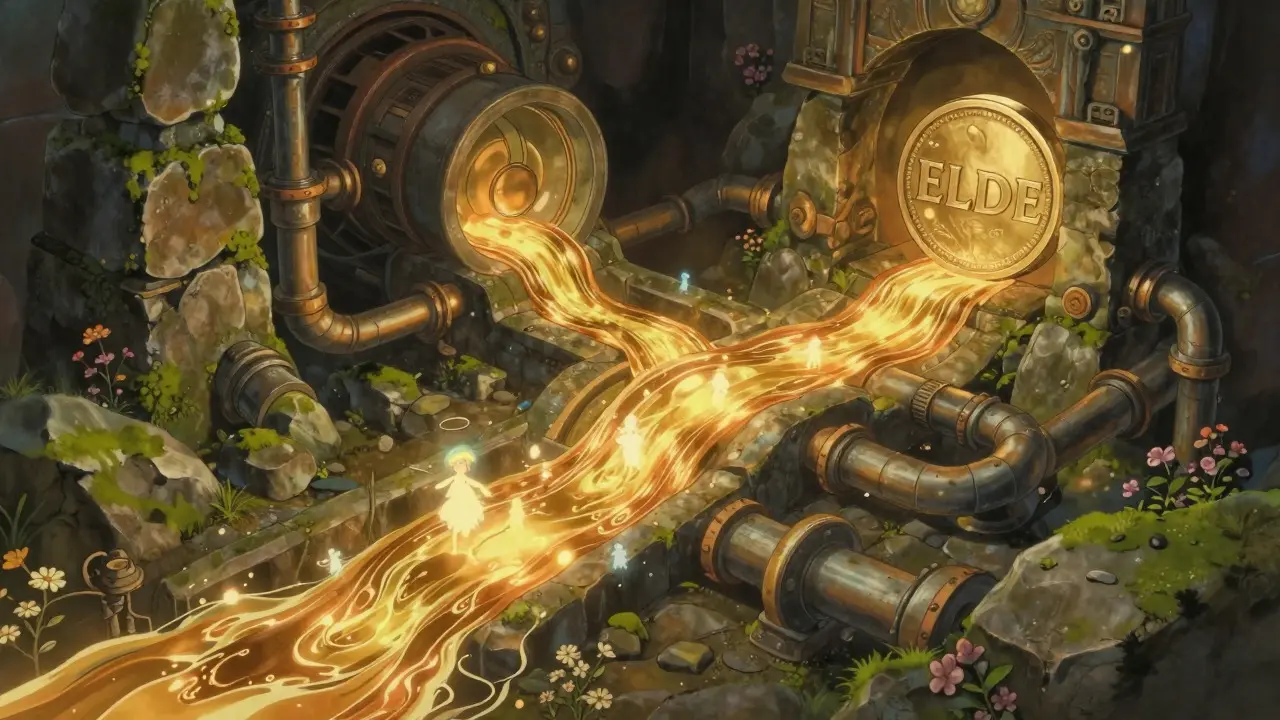
The role of ELDE here is central. It is not just a reward; it is the fuel for the entire economy. You use it to buy energy boosters, access premium missions, trade NFTs, and recruit AI heroes. Because the supply is capped, the developers aim to create scarcity that mirrors real-world economic principles, hoping that increased player activity drives up demand for the token.
Tokenomics: Supply, Distribution, and Emission Schedule
When analyzing any crypto asset, the tokenomics tell you how much inflation to expect. For ELDE, the numbers are straightforward. The total maximum supply is fixed at 400,000,000 tokens. There is no mechanism for minting new tokens beyond this cap, which is a deflationary or scarcity-conscious design choice.
The distribution of these tokens follows a four-year emission schedule. Here is how the breakdown works:
- Initial Unlock (TGE): At the Token Generation Event on May 27, 2025, 21% of the total supply (84,040,000 ELDE) was unlocked. This portion was distributed among the Community, Foundation, Public Sale participants, and Investors.
- Year 1 Release: A significant chunk, approximately 58.34% of the total supply, is scheduled to be released during the first year. This front-loaded strategy is designed to bootstrap the ecosystem quickly by giving early adopters and investors enough tokens to participate in trading and gameplay.
- Years 2-4 Release: The remaining 41.66% is gradually released over the next three years. This slower drip helps sustain long-term incentives without overwhelming the market with new supply all at once.
- Community Pools: About 31% of the overall supply is allocated to community-focused pools, including Marketing & Ecosystem, Additional Incentives, and Airdrops. These funds are intended to keep user engagement high through rewards and promotional activities.
Circulating supply figures vary widely depending on when you check. Some trackers show around 84 million in circulation shortly after launch, while others report figures closer to 212 million or even 254 million by mid-2026. This discrepancy highlights the importance of checking the specific date of your data source, as vesting schedules and emissions progress over time.

How ELDE Works in the Game Economy
The value proposition of ELDE relies heavily on its utility within the Elderglade ecosystem. If players stop playing, the token loses its primary use case. Therefore, understanding the in-game mechanics is crucial for assessing the token's potential.
Here are the main ways players interact with ELDE:
- In-Game Purchases: Basic resources, energy refills, and mission entries cost ELDE. This creates constant demand from active players.
- NFT Trading: Characters, weapons, and buildings are NFTs. Buying, selling, or upgrading these assets requires ELDE, creating a secondary market driven by player-to-player transactions.
- Staking Rewards: Players can stake ELDE to earn special NFT rewards or other in-game benefits. This encourages holding rather than immediate selling, potentially reducing sell pressure.
- Tavern Revenue Sharing: One of the unique features is the "Tavern" NFT. Owners of these virtual properties earn a percentage of the ELDE generated when they recruit characters. This turns the token into a yield-bearing asset for property owners, similar to real estate rental income.
- AI Hero Recruitment: As the full MMORPG features roll out, ELDE will be used to recruit and upgrade AI-driven heroes, adding another layer of consumption for the token.
This closed-loop design means that almost every action in the game touches the ELDE contract. The goal is to ensure that the token has intrinsic value tied to gameplay hours, not just external speculation.
Where to Buy and Technical Details
If you decide to get involved, accessibility is a major factor. ELDE is listed on several centralized and decentralized exchanges, providing multiple entry points for buyers.
| Attribute | Details |
|---|---|
| Blockchain | BNB Chain (Primary), KAIA Network (Secondary) |
| Token Standard | BEP-20 (ERC-20 compatible logic) |
| Contract Address (BNB) | 0x799a290F9CC4085a0ce5b42b5F2C30193A7a872B |
| Centralized Exchanges | Bybit, KuCoin, MEXC, Gate |
| Decentralized Exchanges | PancakeSwap, DragonSwap |
| Launch Date | April 23, 2025 |
Buying on a centralized exchange like Bybit or KuCoin is the simplest route for most users. You can swap stablecoins or BTC for ELDE directly. For those preferring DeFi, PancakeSwap allows you to swap BNB for ELDE directly on-chain. However, be aware that liquidity on DEXs can be lower than on CEXs, leading to higher slippage for large orders.
One technical nuance worth noting is that while ELDE is primarily a BEP-20 token, it has also been deployed on the KAIA network. This multichain presence adds complexity but also expands the potential user base to regions where KAIA is more popular. When sending tokens, always double-check the network to avoid losing funds in the wrong chain.
Price Volatility and Market Data Discrepancies
Like many microcap GameFi tokens, ELDE suffers from data inconsistency across tracking platforms. This is not necessarily a sign of fraud, but rather a result of low liquidity and varying update frequencies among data providers.
For instance, some sources reported prices near $0.149 in late 2025, while others showed prices dropping to fractions of a cent ($0.00005) by late 2026. These extreme variances suggest that the token experienced significant volatility, possibly due to market sentiment shifts, unlock events, or changes in trading volume. When you see such wide ranges, it is critical to check the timestamp of the data. A price quote from six months ago is useless for making a decision today.
Liquidity is another concern. On some days, 24-hour trading volume might be as low as $15 on certain DEXs, while on others, it could reach thousands of dollars on CEXs. Thin liquidity means that buying or selling a large amount of ELDE can move the price against you significantly. If you plan to hold a large position, consider entering and exiting in smaller chunks to minimize impact costs.
Risk Factors and Things to Watch
Investing in ELDE comes with specific risks that differ from mainstream cryptocurrencies like Bitcoin or Ethereum. First, there is the execution risk. The game must deliver on its promise of an engaging AI-driven MMORPG. If the gameplay feels clunky or the AI integration is weak, player retention will drop, and with it, the demand for ELDE.
Second, there is the opacity of team and governance details. While the tokenomics are public, detailed information about the core development team, their backgrounds, and future roadmap milestones is less transparent compared to blue-chip projects. This lack of visibility makes it harder for investors to verify long-term commitment.
Finally, regulatory uncertainty in the GameFi sector remains a background risk. While BNB Chain is generally well-regarded, specific jurisdictions may view play-to-earn tokens differently. Always check local regulations before investing.
Frequently Asked Questions
Is Elderglade (ELDE) a good investment in 2026?
Whether ELDE is a good investment depends on your risk tolerance. It is a high-risk, high-reward asset tied to the success of a specific game. If you believe in the growth of AI-driven Web3 gaming and the Elderglade team's ability to execute, it may offer upside. However, given the thin liquidity and data discrepancies, it should only form a small part of a diversified portfolio.
What is the maximum supply of ELDE?
The maximum supply of ELDE is fixed at 400,000,000 tokens. No more tokens will ever be created beyond this cap, which helps maintain scarcity over time.
Which blockchain does ELDE run on?
ELDE primarily runs on the BNB Chain using the BEP-20 standard. It has also been deployed on the KAIA network, making it a multichain asset. Always verify the correct network address before transferring tokens.
How do I buy Elderglade coins?
You can buy ELDE on centralized exchanges like Bybit, KuCoin, MEXC, or Gate. Alternatively, you can swap BNB for ELDE on decentralized exchanges like PancakeSwap or DragonSwap. Ensure you have a wallet that supports BNB Chain if using DEXs.
Why do ELDE prices differ so much between websites?
Price discrepancies occur because different platforms aggregate data from different exchanges and update at different speeds. Low liquidity exacerbates this, as small trades can cause large price swings on one platform that aren't reflected elsewhere. Always cross-reference multiple sources and check the timestamp of the data.