14
How Venezuela Uses Crypto to Evade Sanctions: The PETRO, PDVSA, and USDT Networks

When the United States and European Union slapped heavy sanctions on Venezuela, a country once known for its vast oil reserves but now grappling with economic collapse, the Maduro regime didn't just accept the financial isolation. Instead, they turned to a digital loophole that traditional banking systems couldn't easily close: cryptocurrency. What started as an attempt to combat hyperinflation has evolved into a sophisticated state-sponsored strategy to bypass international restrictions, launder money, and keep the government's lifeblood-oil exports-flowing.
This isn't just about ordinary citizens buying Bitcoin to save their savings from devaluation. It’s about a coordinated effort by the Venezuelan state to use digital assets as a shield against Western pressure. From the launch of the state-backed PETRO to the widespread use of Tether (USDT) by the national oil company, the lines between legitimate finance and sanctions evasion have blurred significantly.
The Birth of PETRO: A State-Backed Evasion Tool
In 2018, President Nicolas Maduro introduced the PETRO, Venezuela's official national cryptocurrency. On paper, it was marketed as a way to stabilize the economy and attract foreign investment. In reality, it was designed from day one to circumvent U.S. sanctions. The token was backed by oil reserves, theoretically giving it value, but its primary function was to create a parallel financial system outside the reach of Western banks.
The U.S. Department of the Treasury’s Office of Foreign Assets Control (OFAC) quickly identified the PETRO as a violation of existing sanctions. They argued that purchasing PETRO constituted an extension of credit to the Venezuelan government, which was prohibited under Executive Order 13692. Despite these warnings, the regime pushed forward, hoping to find buyers willing to ignore the legal risks. While the PETRO never gained significant traction globally due to its lack of transparency and liquidity issues, it set the precedent for using blockchain technology as a political tool.
The failure of PETRO as a mainstream asset didn’t stop the government. Instead, it signaled a shift toward more flexible, decentralized cryptocurrencies that offered greater anonymity and ease of transfer.
PDVSA and the Oil-Crypto Pipeline
If PETRO was the experiment, PDVSA, the state-owned oil company, became the workhorse of Venezuela’s crypto-based sanctions evasion. With access to traditional correspondent banking cut off, PDVSA needed a new way to sell its oil and receive payment. Enter cryptocurrency.
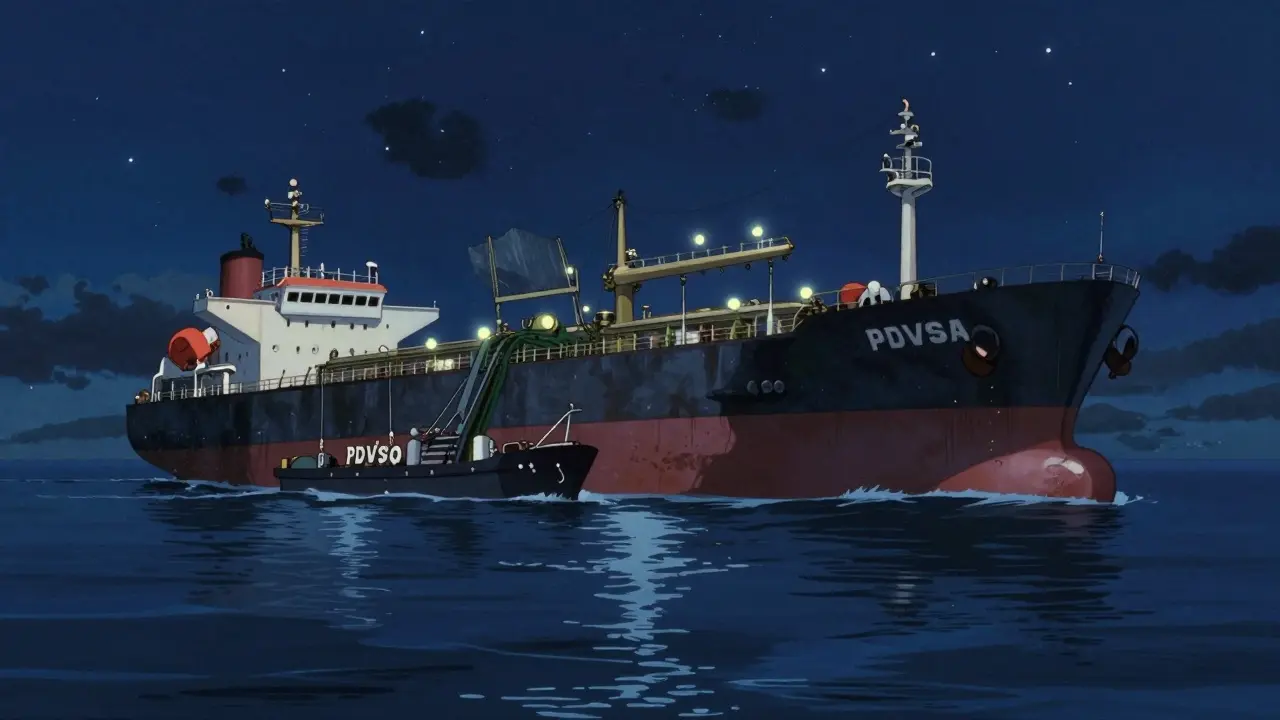
In October 2022, the U.S. Department of Justice unsealed indictments revealing how five Russian nationals helped PDVSA evade sanctions through complex cryptocurrency schemes. These individuals facilitated ship-to-ship transfers of oil in international waters, allowing the crude to be sold without triggering alerts in Western financial systems. Payments were then processed through cryptocurrency intermediaries, often involving stablecoins like Tether (USDT).
Stablecoins are particularly attractive for this purpose because they minimize price volatility. Unlike Bitcoin, which can swing wildly in value, USDT is pegged to the U.S. dollar, making it easier to calculate transaction values and settle debts. This stability makes it ideal for large-scale commodity trades where predictability is crucial.
| Cryptocurrency | Primary Use Case | Anonymity Level | Volatility Risk |
|---|---|---|---|
| Bitcoin | Wealth preservation, general transfers | Moderate (public ledger) | High |
| Tether (USDT) | Trade settlement, illicit finance | Low-Moderate (traceable but opaque) | Low (pegged to USD) |
| Monero (XMR) | Privacy-focused transactions | High (encrypted transactions) | Medium |
| PETRO | State-backed debt instrument | Low (government-controlled) | N/A (illiquid) |
The DOJ case highlighted how these networks operate: oil is moved discreetly, payments are made in crypto, and the funds are eventually converted back to fiat currency or used to purchase goods abroad. This process effectively neutralizes the impact of sanctions by removing the need for traditional bank accounts in sanctioned jurisdictions.
State-Controlled Exchanges and Local Infrastructure
To make this system work, Venezuela needed local infrastructure. The government authorized seven cryptocurrency exchanges to operate within the country, ostensibly to promote financial inclusion. However, many of these platforms are directly controlled by state entities.
Take Criptolago, for example. Owned by Zulia state-the heart of Venezuela’s oil industry-it is managed by Governor Omar Prieto, a loyalist to Maduro who is himself under U.S. sanctions for blocking humanitarian aid. Criptolago serves as a hub for converting fiat bolivars into cryptocurrencies, facilitating both domestic trade and cross-border transfers.
These exchanges act as gateways for individuals connected to the Maduro administration to receive funds from sanctioned jurisdictions. By routing transactions through locally controlled platforms, the government maintains oversight while creating plausible deniability regarding the ultimate beneficiaries of those funds.
Additionally, over-the-counter (OTC) brokers in Caracas have emerged as key players in this ecosystem. Operating informal cash-to-crypto markets, these brokers provide critical infrastructure for moving money out of the country. They offer higher privacy than regulated exchanges, making them attractive for those seeking to avoid detection.
The Role of Stablecoins in Illicit Finance
While Bitcoin gets most of the attention, stablecoins like Tether (USDT) play a far more significant role in sanctions evasion. Their stability makes them ideal for settling large transactions without exposing parties to market risk. For countries like Venezuela, which suffer from extreme inflation, holding dollars digitally via USDT offers a semblance of security.
Financial intelligence firm Sayari has reported that transnational criminal networks increasingly rely on USDT for cross-border value transfers. Hezbollah-linked money launderers, for instance, have been documented using Tether to move funds between Syria, Iran, and other sanctioned regions. Similarly, Venezuelan entities exploit the same mechanisms to facilitate oil sales and repatriate profits.
The challenge for regulators lies in tracing these flows. While blockchain technology provides a transparent ledger, the identity behind each wallet address remains hidden unless additional information is available. OTC brokers and mixers further complicate efforts to track the origin and destination of funds.
Impact on Ordinary Citizens vs. Criminal Networks
It’s important to distinguish between two groups benefiting from Venezuela’s crypto boom: ordinary citizens trying to survive and criminal networks exploiting the chaos.
For everyday Venezuelans, cryptocurrency represents a lifeline. With hyperinflation eroding the value of the bolivar, many turn to Bitcoin or USDT to preserve their wealth. Reddit discussions and financial forums document countless stories of people successfully protecting their purchasing power through crypto adoption. Some even earn income by providing services online and receiving payments in digital currencies.
However, this same infrastructure enables illicit activities. Money laundering experts warn of red flags such as unusual stablecoin transfer patterns, connections to oil sector entities, and involvement with known OTC brokers. Financial institutions struggle to differentiate between legitimate users and those engaged in sanctions evasion, leading some to sever ties entirely with any entity showing Venezuelan exposure.
This duality creates a moral dilemma: restricting access could harm innocent civilians, yet allowing unrestricted use empowers corrupt regimes and criminal organizations.

Global Implications and Future Trends
Venezuela’s experience hasn’t gone unnoticed. Other sanctioned nations, including Russia, have studied its approach closely. Following the invasion of Ukraine in February 2022, Russia faced unprecedented Western sanctions. In response, its Ministry of Finance began exploring virtual currency settlement mechanisms for cross-border transactions-a clear nod to Venezuela’s model.
Industry analysts estimate that sanctioned entity cryptocurrency usage has grown substantially since 2018. As enforcement measures intensify, expect to see increased adoption of privacy-focused coins like Monero and decentralized finance protocols that reduce reliance on centralized intermediaries.
Blockchain analysis tools are also evolving. Companies like Chainalysis specialize in identifying suspicious activity across multiple blockchains. Yet, as long as there is demand for alternative payment methods, sanctioned actors will continue innovating ways to exploit weaknesses in global financial surveillance.
Challenges for Compliance Professionals
For fintech companies and banks operating globally, navigating Venezuelan-related cryptocurrency risks is increasingly difficult. Enhanced due diligence procedures require specialized knowledge of blockchain analytics, international regulations, and emerging evasion techniques.
Compliance teams must monitor for indicators such as:
- Transactions involving Venezuelan OTC brokers
- Frequent conversions between stablecoins and illiquid tokens
- Links to entities associated with PDVSA or other sanctioned organizations
- Unusual geographic routing of funds
Failure to detect these patterns can result in severe penalties, including loss of correspondent banking relationships and hefty fines from regulatory bodies.
What is the PETRO cryptocurrency?
The PETRO is Venezuela’s state-backed cryptocurrency launched in 2018. Backed by oil reserves, it was intended to stabilize the economy and evade U.S. sanctions. However, it failed to gain widespread acceptance due to lack of transparency and liquidity issues.
How does PDVSA use cryptocurrency to evade sanctions?
PDVSA uses cryptocurrencies like Tether (USDT) to receive payments for oil exports without relying on traditional banking channels. Ship-to-ship transfers combined with crypto settlements allow the company to bypass Western financial restrictions.
Why are stablecoins preferred for sanctions evasion?
Stablecoins like USDT maintain a fixed value relative to fiat currencies, reducing volatility risks during large transactions. This makes them ideal for settling trade deals and moving money discreetly across borders.
Are regular Venezuelans affected by these crypto operations?
Yes, but differently. Many ordinary citizens use Bitcoin and stablecoins to protect their savings from hyperinflation. Meanwhile, criminal networks exploit the same infrastructure for illicit purposes, complicating enforcement efforts.
Can blockchain analysis prevent sanctions evasion?
Blockchain analysis tools help identify suspicious patterns, but they cannot fully eliminate evasion. Privacy features, OTC brokers, and mixing services create obstacles for tracking funds, requiring continuous innovation in compliance strategies.










Sudarshan Anbazhagan
May 15, 2026 AT 06:33the entire premise of this article is deeply flawed because it ignores the fundamental reality that sanctions are merely economic warfare tools designed to starve populations into submission while the elite maintain their grip on power through shadow banking networks that operate far beyond the reach of any western regulatory body. one must understand that the petro was not a failure but rather a deliberate decoy to draw attention away from the more sophisticated stablecoin channels that actually facilitate the bulk of illicit trade. the notion that blockchain transparency allows for easy tracking is laughable when you consider the sheer volume of noise generated by mixers and tumblers which effectively obscure the origin of funds. furthermore the comparison between bitcoin and tether fails to account for the liquidity depth required for state-level transactions where volatility is indeed a concern but anonymity is paramount. it is disingenuous to suggest that ordinary citizens are the primary beneficiaries when the infrastructure itself is controlled by state loyalists who have no interest in financial inclusion for the masses. the real story here is how decentralized finance protocols are being weaponized against traditional fiat systems creating a new paradigm for sovereign wealth management that operates outside the jurisdiction of the treasurys office of foreign assets control.
Amit Varpe
May 16, 2026 AT 15:00us hypocrisy at its finest :D they sanction everyone then complain when people find ways around it
Bronwen Butler
May 17, 2026 AT 23:58actually the petro was never really about evading sanctions it was about controlling the narrative domestically and the whole crypto angle is just a convenient scapegoat for their own mismanagement of resources. most of these so called evasion techniques are just standard trade practices that happen to use digital currencies as a medium of exchange rather than an end in themselves. the idea that this is some grand conspiracy is overstated.
Matt Davis
May 19, 2026 AT 01:11This is absolutely preposterous! The suggestion that PDVSA is merely using cryptocurrency as a tool for legitimate trade settlement is utterly absurd given the complete lack of transparency and the well-documented involvement of sanctioned entities in these transactions. One cannot simply wave away the implications of ship-to-ship transfers in international waters as if they were routine commercial activities. This is blatant disregard for international law and a direct challenge to the global financial order, and anyone who argues otherwise is either willfully ignorant or complicit in the deception.
Albert Lee
May 19, 2026 AT 22:18I really appreciate how this post breaks down the technical aspects of how stablecoins are utilized in such complex geopolitical scenarios. It’s incredibly insightful to see the distinction between the intended use of crypto for wealth preservation versus its exploitation for sanctions evasion. I hope this information helps others understand the nuances involved without resorting to simplistic narratives. Your analysis provides a much-needed perspective on the challenges faced by compliance professionals today.
Ankush Pokarana
May 20, 2026 AT 16:03one might ponder the philosophical implications of a currency that exists only in the digital realm yet holds the power to destabilize nations. the very essence of value is questioned when trust is placed in algorithms rather than institutions. it is a fascinating paradox that technology meant to liberate individuals from centralized control can simultaneously be co-opted by those same central authorities to maintain their grip on power. perhaps the true lesson here is not about the mechanics of blockchain but about the human tendency to seek shortcuts around established norms regardless of the ethical consequences.
Bianca Vilas Boas Lourenço
May 20, 2026 AT 18:28ugh another boring take on venezuela 🙄 like we haven't heard this before. the drama of it all is just exhausting to read about 😩
Yash Lodha
May 21, 2026 AT 23:13the deeper you dig the more you realize that this is all part of a larger globalist agenda to erode national sovereignty through financial instruments that cannot be regulated by any single nation state. the petro was just the tip of the iceberg designed to test the waters for a fully decentralized monetary system that would render traditional banking obsolete. those who control the flow of information control the flow of money and this is exactly what they are trying to achieve with these crypto schemes.
Jesse Alston
May 22, 2026 AT 18:14Great breakdown of the mechanisms involved! 👍 For those interested in the technical side, it's worth noting that while USDT is often cited as the primary vehicle, other stablecoins like USDC and DAI are also seeing increased usage due to their varying degrees of decentralization and regulatory compliance. The key takeaway is that the infrastructure is becoming more robust and harder to dismantle completely.
Sarah C
May 23, 2026 AT 02:03I agree with the point about the moral dilemma faced by financial institutions. It’s a difficult balance to strike between enforcing regulations and not harming innocent civilians who rely on these technologies for survival. We need more nuanced approaches to compliance that can distinguish between legitimate users and malicious actors.
Sharada Vakkund
May 24, 2026 AT 15:38This is a really important discussion and I think it highlights the need for greater financial literacy among the general public. Understanding how these systems work can empower individuals to make better decisions about their own finances and protect themselves from potential risks associated with unregulated platforms.
John Gonzalez Bentham
May 24, 2026 AT 17:15thats bs the petro was a total scam from day one and nobody fell for it except maybe a few gullible investors who didnt do their homework. the whole thing was just propaganda to distract from the fact that the government had no real plan to fix the economy.