6
International Response to North Korean Crypto Crime: How the World Is Fighting Back
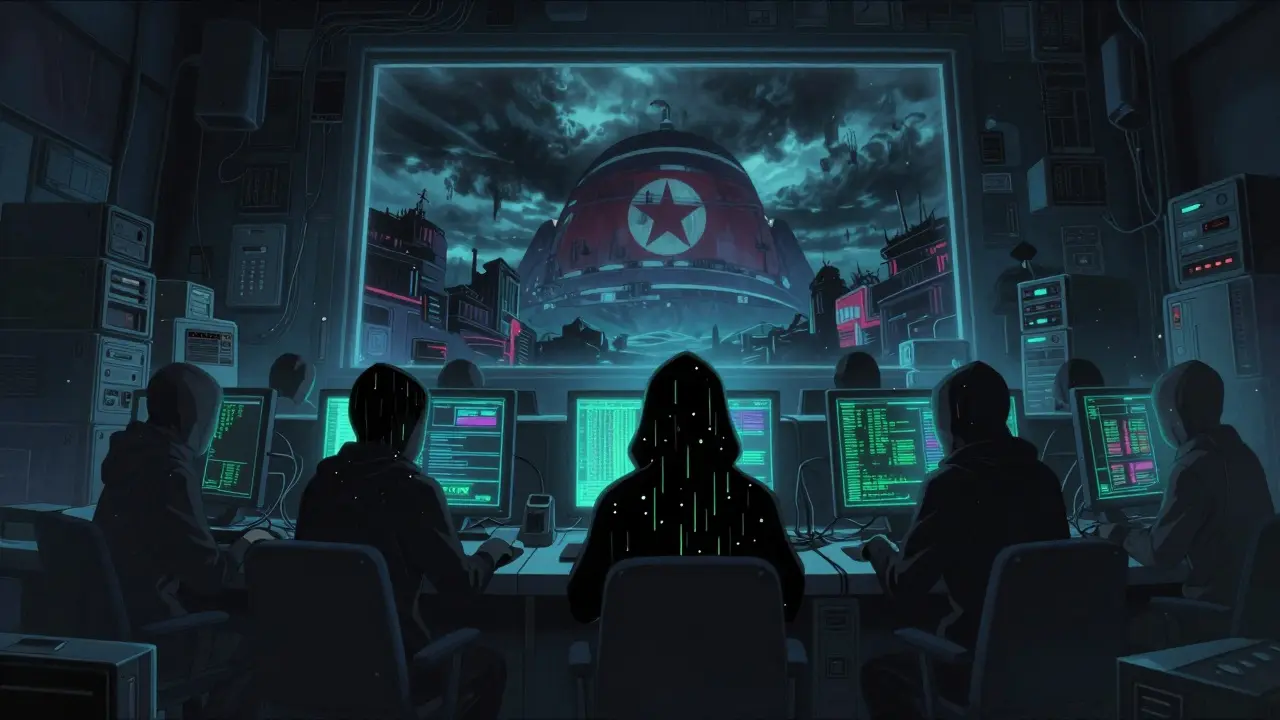
Imagine a government that doesn’t just spy on you but actively steals from your digital wallet to fund its weapons program. That is the reality we are facing with North Korea, officially known as the Democratic People's Republic of Korea (DPRK), which has turned cybercrime into a national industry. For years, this regime used hacking as a covert tool. Today, it is their primary source of hard currency. In the first half of 2025 alone, they stole over $2.17 billion in cryptocurrency. The February 2025 hack of the ByBit exchange, where $1.5 billion vanished, was not just a bad day for investors; it was a record-breaking event in the history of financial theft.
The old way of handling this-relying on the United Nations Panel of Experts-stopped working when that panel was dissolved in May 2024. This left a massive gap in global enforcement. If you thought the world just shrugged and accepted these losses, you’d be wrong. A new coalition formed to fill the void, changing how nations track, freeze, and fight state-sponsored digital crime.
The New Enforcers: The Multilateral Sanctions Monitoring Team
When the UN mechanism fell apart, eleven countries didn't wait for permission to act. In October 2024, they launched the Multilateral Sanctions Monitoring Team (MSMT). This group includes the United States, the United Kingdom, Japan, South Korea, Canada, Australia, France, Germany, Italy, the Netherlands, and New Zealand. Think of them as the elite task force for crypto sanctions. Unlike the UN, which requires consensus from all members (including those who might protect North Korea), the MSMT operates as an agile coalition of like-minded nations.
Why does this matter to you? Because the MSMT changed the rules of engagement. They don't just report violations; they actively share intelligence in real-time. Their October 2025 joint statement, released in Ottawa, described North Korea’s operations as a "sophisticated global criminal enterprise." By consolidating data from these twelve economies, they can trace money flows that previously slipped through the cracks between jurisdictions. This shift from a slow, bureaucratic UN process to a faster, targeted coalition model is the biggest change in international crypto security since Bitcoin launched.
Who Is Behind the Hacks?
To stop the crime, you need to know the criminal. The main actor here is the Lazarus Group, a hacker collective linked directly to North Korea’s Reconnaissance General Bureau. This isn't a loose band of teenage coders in basements. It is a state-directed entity. The UN has designated the Reconnaissance General Bureau as a sanctioned entity because its funds go straight to Pyongyang’s nuclear and missile programs.
In 2024, North Korea accounted for about 35% of all cryptocurrency stolen globally. By early 2025, that number climbed. The cumulative value of known DPRK-linked thefts now exceeds $6 billion. But they aren't just breaking into exchanges anymore. They are infiltrating companies. Thousands of North Korean IT workers use fake identities to get hired by Western tech firms. While they write code for their employers, they also conduct espionage and set up backdoors for future attacks. The MSMT has documented this dual-use strategy extensively, showing how economic infiltration supports military goals.
How Blockchain Forensics Catches State Actors
You might wonder how anyone tracks money on a decentralized ledger. The answer lies in specialized analytics firms like Chainalysis, a leading provider of blockchain analysis software, Elliptic, and TRM Labs. These companies provide the "eyes" for the MSMT. They combine transaction tracing with traditional intelligence to identify patterns unique to North Korean hackers.
For example, after the LND.fi hack in 2025, coordinated action between these firms and five MSMT nations froze $237 million in stolen funds within just 72 hours. That speed is unprecedented. Previously, recovering assets took months or years, allowing criminals to launder the money beyond recognition. Now, the protocol is faster. When a hack happens, alerts trigger immediate freezes across compliant exchanges in participating countries.
| Feature | UN Panel of Experts (Pre-2024) | Multilateral Sanctions Monitoring Team (Current) |
|---|---|---|
| Decision Making | Consensus-based (slow, often blocked) | Coalition-based (agile, rapid response) |
| Member Count | All UN Member States | 11 Key Allied Nations |
| Intelligence Sharing | Limited, public reports only | Real-time, private sector integration |
| Asset Recovery Speed | Months to Years | Hours to Days (e.g., 72-hour LND.fi freeze) |

The Technical Arms Race: AI and Privacy Coins
North Korea is not sitting still. They have adapted quickly to the new pressure. The MSMT’s October 2025 report highlights a worrying trend: the use of artificial intelligence. Hackers are using generative AI to create highly convincing social engineering emails and deepfake audio calls. Between July and September 2025, three major technology firms were breached because employees trusted AI-generated messages that bypassed traditional security checks.
They are also getting better at hiding their tracks. In the first half of 2025, analysts identified 17 different wallet clustering techniques used by DPRK actors to obscure the origin of stolen funds. They increasingly use privacy coins like Monero and decentralized exchanges (DEXs) to break the chain of custody. This forces defenders to upgrade their tools constantly. Global spending on blockchain analytics jumped 63% in 2025 to $2.8 billion, reflecting the urgency of this arms race.
Regulatory Changes You Need to Know
The political response has translated into strict new laws. In April 2025, the US implemented Executive Order 14155. This order requires all cryptocurrency exchanges operating in the US to perform enhanced due diligence on any transaction over $10,000. If you run a business involving crypto, this means more paperwork and stricter verification.
Europe is following suit. The EU’s MiCA II regulations, effective January 1, 2026, will establish the first comprehensive framework for cross-border crypto monitoring. These rules aim to close the loopholes that allow money to hop between jurisdictions instantly. However, compliance is expensive. Smaller platforms estimate costs at $1.2 million annually, which could lead to consolidation in the industry as smaller players struggle to afford the necessary security infrastructure.

Challenges and Gaps in the Current System
Despite the progress, the system isn't perfect. One major issue is the "gap in global coverage." The MSMT consists of 11 nations, but many other countries are not involved. North Korea exploits this by routing transactions through non-participating jurisdictions with weaker regulations. Additionally, the deepening alliance between North Korea and Russia complicates matters. As noted by experts at War on the Rocks, geopolitical tensions make coordinated action harder when key global powers have conflicting interests.
Recovery rates remain low. Even with 17 civil forfeiture cases filed by the US Department of Justice in the first nine months of 2025 targeting $214 million in assets, only about 12.3% of seized values are actually recovered. The rest gets lost in the complex web of mixing services and privacy-enhancing technologies. This frustration is echoed by security officers on forums like Reddit, who complain about the slow pace of cross-border asset recovery despite improved threat intelligence.
What Comes Next?
The fight is evolving. The MSMT plans to launch a dedicated Cryptocurrency Intelligence Fusion Cell in early 2026, funded with $85 million. This unit will operate like a counterterrorism center, focusing exclusively on real-time tracking of DPRK funds. Their goal is to implement standardized protocols for real-time monitoring across all member nations by Q3 2026.
For individuals and businesses, the message is clear: vigilance is no longer optional. The era of anonymous, untraceable large-scale transfers is ending in regulated markets. As AI-powered attacks become more common, human error remains the biggest vulnerability. Training staff to recognize sophisticated phishing attempts is just as important as installing firewalls.
What is the Multilateral Sanctions Monitoring Team (MSMT)?
The MSMT is a coalition of 11 nations (including the US, UK, Japan, and South Korea) established in October 2024 to replace the dissolved UN Panel of Experts. It focuses on monitoring and reporting North Korean sanctions violations, particularly those involving cryptocurrency theft and laundering.
How much money has North Korea stolen via crypto?
As of mid-2025, the cumulative known value of DPRK-linked cryptocurrency thefts exceeds $6 billion. In the first half of 2025 alone, they generated over $2.17 billion in illicit gains, with the single largest heist being the $1.5 billion ByBit hack in February 2025.
Who is the Lazarus Group?
The Lazarus Group is a notorious hacker collective attributed to North Korea’s Reconnaissance General Bureau. They are responsible for most of the state’s cyber-heists and use the proceeds to fund the country’s weapons programs.
Can I recover my funds if I am hacked by North Korean actors?
Recovery is difficult but improving. While the overall recovery rate is around 12.3%, recent coordinated efforts have allowed for faster freezing of assets. For example, $237 million was frozen within 72 hours after the LND.fi hack. Reporting immediately to authorities and using exchanges that cooperate with the MSMT increases your chances.
What are the new regulations for crypto exchanges in 2026?
In the US, Executive Order 14155 requires enhanced due diligence for transactions over $10,000. In Europe, the MiCA II regulations take effect on January 1, 2026, establishing strict cross-border monitoring frameworks. These rules aim to prevent money laundering by state-sponsored actors.