11
Largest Bitcoin Mining Pools in 2026: Who Controls the Network and What You Need to Know

When you hear about Bitcoin being mined, you might picture a lone miner with a rack of ASICs in a garage. But the truth is, almost no one mines alone anymore. Instead, thousands of miners join forces in Bitcoin mining pools - groups that combine computing power to find blocks more often and split the rewards. This isn’t just convenient; it’s how the network actually works today. If you’re mining Bitcoin, you’re almost certainly in a pool. And not just any pool - the top five control nearly 70% of the entire network’s hash rate.
Who Are the Top Bitcoin Mining Pools Right Now?
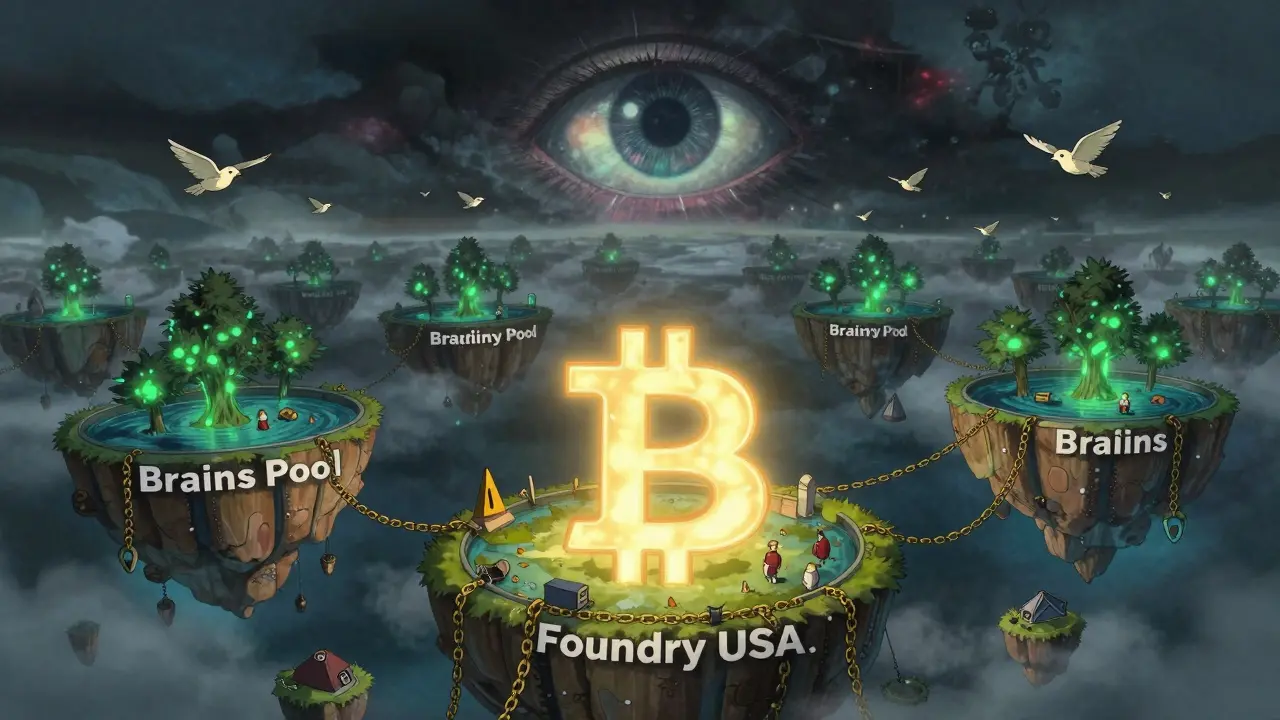
As of October 2025, the five largest Bitcoin mining pools - according to Blockchain.com’s real-time data - are Foundry USA, Antpool, F2Pool, ViaBTC, and Braiins Pool. Together, they handle over 70% of all Bitcoin mining activity. That’s a massive concentration of power. But each one operates differently, and choosing the right one matters more than you think.
Foundry USA leads the pack with around 30% of the network’s hash rate. Launched in 2020 by Digital Currency Group, it’s the biggest player in North America. It uses a payout system called FPPS (Full Pay Per Share), which means miners get paid for both block rewards and transaction fees - no matter what. That’s great for steady income. But there’s a catch: Foundry USA requires strict KYC (Know Your Customer) verification. If you’re mining over 10 PH/s, you need to submit business documents. That’s a barrier for privacy-focused miners, but it also makes the pool more compliant with regulators.
Antpool, run by Bitmain, sits at 18.76% of the network. Bitmain also makes the most popular ASIC miners, so it’s no surprise Antpool is so big. It offers two payout options: PPLNS (Pay Per Last N Shares), which is free but has fluctuating payouts, and PPS+ (Pay Per Share Plus), which charges a 4% fee on block rewards and 2% on transaction fees. PPS+ gives you predictable earnings, but you’re paying for that stability. Users on Trustpilot report delays during high-traffic periods - like after the April 2025 halving - with payouts sometimes taking over 36 hours.
F2Pool, founded in 2013, holds 12.39% of the network. It’s one of the few pools that supports multiple cryptocurrencies - Bitcoin, Litecoin, Ethereum Classic - so it’s popular with miners who switch between coins. But its Chinese roots raise questions. With China’s strict crypto policies still in place, there’s no guarantee F2Pool will stay operational long-term. Some miners worry about sudden shutdowns or regulatory crackdowns.
ViaBTC, with 10.55% of the hash rate, stands out for its tools. It has one of the best dashboards for tracking miner performance, and its global server network keeps connection latency low. It uses both PPLNS and FPPS models. That’s a good middle ground, but it doesn’t have the same scale as Foundry or Antpool. It’s reliable, but not a market leader.
Braiins Pool - the original pioneer - is down to 5-7%. Founded in 2010 as Slushpool, it was the first mining pool ever. Today, it’s known for innovation. It offers 0% pool fees thanks to its BraiinsOS+ firmware, which boosts mining efficiency by up to 25%. That’s huge. It also allows anonymous mining, with no KYC required. New users can start with just 1 PH/s, and payouts start at 0.001 BTC. Reddit users love it: one miner reported consistent daily payouts of 0.0015 BTC on an S19j Pro over eight months with zero downtime. But because it’s smaller, it has less influence on network decisions.
How Do Payout Models Actually Work?
Not all mining pools pay the same way. The payout model you choose affects your income, risk, and predictability. Here’s what you’re really signing up for:
- PPLNS (Pay Per Last N Shares): You get paid based on the shares you contributed during the last N shares before a block was found. It’s fair - you’re rewarded for your actual contribution. But it’s also volatile. If the pool finds a block right after you join, you might get nothing. If you leave just before a block, you lose out. This model has no fees, but you need patience and steady mining.
- PPS (Pay Per Share): You get paid immediately for every valid share you submit. No waiting. No risk. But the pool takes a fee - usually 2-5% - to cover its own risk. It’s like buying insurance on your mining income.
- PPS+ (Pay Per Share Plus): This adds transaction fees to PPS. You get paid for shares + a share of the fees from transactions in the block. It’s the most stable option, but fees are higher. Antpool and ViaBTC use this.
- FPPS (Full Pay Per Share): Foundry USA uses this. It pays you for shares + all transaction fees, and it guarantees the payout even if the block doesn’t include fees. This is the most miner-friendly model, but it’s only offered by a few pools because it’s expensive for them to run.
Most miners prefer PPS+ or FPPS for steady income. PPLNS is for those who want maximum reward over time and don’t mind waiting. If you’re mining for profit, not hobby, stick with PPS+ or FPPS.
Why Centralization Is a Real Problem
Bitcoin was built to be decentralized. No banks. No governments. Just code and consensus. But mining pools are changing that.
Foundry USA alone controls 30% of the network. That’s more than the next two biggest pools combined. If that pool went offline - or worse, was hacked or coerced - it could disrupt Bitcoin’s ability to confirm transactions. Experts like Dr. Alex de Vries from Digiconomist warn this level of concentration threatens Bitcoin’s core promise. And it’s not just about one pool. Together, the top five control 70%. That leaves only 30% for everyone else.
Then there’s the 53.099% of hash rate that’s labeled “Unknown” on Blockchain.com. That’s not magic - it’s untracked mining. Some believe this hidden portion actually helps decentralization by hiding where mining is concentrated. Others say it’s just a cover for large operators who don’t want to be seen. Either way, no one knows who controls that portion.
And then there’s Bitmain. Antpool runs on Bitmain hardware. Bitmain makes the ASICs. Bitmain controls the pool. That’s vertical integration - and it’s dangerous. If Bitmain decides to change the rules, or if regulators target it, the whole chain could wobble.
The U.S. SEC has already started looking at mining pools. In October 2025, they said some payout structures - like PPS+ - might be considered securities. That could force pools to register, disclose financials, or even shut down. Braiins and Foundry USA are already preparing. Braiins added zero-knowledge proof tech to verify operations without revealing miner identities. Foundry USA is working with regulators. The others? Not so much.

What You Should Look for When Choosing a Pool
Not all pools are created equal. Here’s what actually matters:
- Payout Model: Pick FPPS or PPS+ for steady income. Avoid PPLNS unless you’re mining full-time and can handle fluctuations.
- Fees: Braiins has 0% fees. Others charge 1-5%. That adds up over time. A 3% fee on 10 BTC/month = 0.3 BTC lost. That’s $20,000 a year.
- KYC Requirements: If you care about privacy, avoid Foundry USA. Go with Braiins or F2Pool. But if you’re a business or institutional miner, KYC is inevitable - and sometimes a plus for compliance.
- Uptime and Reliability: Foundry USA has a 4.7/5 rating from 892 verified reviews. Braiins has 9.5/10 for innovation. Antpool? 4.1/5 with complaints about delays. Don’t ignore reviews.
- Protocol Support: All new miners should use Stratum V2. It’s more secure than V1. Foundry USA and ViaBTC support it. Antpool and F2Pool are still catching up.
- Customer Support: Braiins responds to emails in under 2 hours. Antpool takes over 8. That’s a night-and-day difference when your miner stops working.
Also, don’t put all your hash rate in one pool. Deloitte’s 2025 survey found 62% of institutional miners use at least two pools. It’s a simple way to reduce risk. Split your miners: 60% in Foundry USA for stability, 30% in Braiins for low fees, 10% in ViaBTC for redundancy.
The Future of Mining Pools
The mining pool landscape is changing fast. By 2027, J.P. Morgan predicts only 3-4 pools will control over 60% of the network. That’s not a future - it’s a likely outcome.
Regulations are tightening. The EU’s MiCA framework requires all pools serving European users to implement full KYC by Q1 2026. That’s coming. Braiins and Foundry USA are already compliant. F2Pool? Not so much. If you’re mining from Europe, you’ll be forced to switch.
Technology is evolving too. Braiins Farm 2.0 reduces connection overhead by 40%. That means less wasted power, faster payouts, and better efficiency. Stratum V2 adoption is at 78% - and growing. Pools that don’t upgrade will be left behind.
And then there’s the quiet threat: Bitcoin Core developers are watching. Luke Dashjr warned that if pool concentration keeps growing, the protocol itself might change. Imagine a rule that makes large pools pay higher fees or limits their block influence. That’s not science fiction - it’s a real possibility. The network’s code could one day penalize centralization.
Right now, you have choices. But those choices are narrowing. The era of dozens of small pools is over. We’re in the age of giants - and the giants are getting bigger.
| Pool | Market Share | Payout Model | Fees | KYC Required | Stratum Version | Min. Withdrawal |
|---|---|---|---|---|---|---|
| Foundry USA | 30% | FPPS | 0% | Yes (10 PH/s+) | V2 | 0.001 BTC |
| Antpool | 18.76% | PPS+, PPLNS | 4-6% | No | V1 | 0.001 BTC |
| F2Pool | 12.39% | PPLNS, PPS | 1-3% | No | V1 | 0.001 BTC |
| ViaBTC | 10.55% | FPPS, PPLNS | 1-3% | No | V2 | 0.001 BTC |
| Braiins Pool | 5-7% | FPPS, PPLNS | 0% | No (optional) | V2 | 0.001 BTC |
Frequently Asked Questions
What is the biggest Bitcoin mining pool in 2026?
As of October 2025, Foundry USA is the largest Bitcoin mining pool, controlling approximately 30% of the network’s total hash rate. It’s followed by Antpool at 18.76%, F2Pool at 12.39%, ViaBTC at 10.55%, and Braiins Pool at 5-7%. These five pools together account for over 70% of all Bitcoin mining activity.
Which mining pool has the lowest fees?
Braiins Pool offers 0% pool fees thanks to its BraiinsOS+ firmware, which improves mining efficiency and eliminates the need for traditional fees. Foundry USA also charges 0% fees under its FPPS model. Other pools like Antpool and F2Pool charge between 1% and 6% depending on the payout method.
Is it safe to use a mining pool with KYC?
Using a KYC pool like Foundry USA increases regulatory compliance and reduces the risk of shutdowns or legal issues. It also improves customer support and accountability. However, it sacrifices privacy. If anonymity is your priority, choose Braiins Pool or F2Pool. Most miners - especially businesses - accept KYC because it provides stability and legal protection.
Should I use multiple mining pools?
Yes. Deloitte’s 2025 mining survey found that 62% of institutional miners use at least two pools to reduce risk. If one pool goes offline, experiences downtime, or gets targeted by regulators, your mining income won’t collapse. Splitting your hash rate between a stable pool like Foundry USA and a low-fee option like Braiins is a smart, low-risk strategy.
What’s the difference between Stratum V1 and V2?
Stratum V1 is the older protocol used by most pools. It’s simple but vulnerable to man-in-the-middle attacks. Stratum V2, adopted by 78% of new connections as of October 2025, adds end-to-end encryption, better authentication, and reduced data overhead. Pools like Foundry USA and ViaBTC support V2. If you’re buying new ASICs, make sure your pool supports V2 - it’s the future.
What’s Next?
If you’re mining Bitcoin today, you’re part of a system that’s becoming more centralized, more regulated, and more corporate. That doesn’t mean it’s broken - it means it’s evolving. The early days of solo mining are gone. The future belongs to those who understand the trade-offs: stability vs. privacy, fees vs. reliability, control vs. compliance.
Don’t just pick the biggest pool. Pick the one that matches your goals. If you’re a business, go with Foundry USA. If you’re privacy-focused, go with Braiins. If you want flexibility, try ViaBTC. And always, always split your hash rate. Because in Bitcoin, the best defense against centralization is not ideology - it’s redundancy.









Douglas Anderson
March 12, 2026 AT 06:55Foundry USA's FPPS model is the gold standard for serious miners. No fee, full transaction fee payout, and Stratum V2 support? That’s the dream. The KYC is annoying, but if you’re running more than 10 PH/s, you’re not a hobbyist anymore. You’re a business. Compliance isn’t a bug-it’s the price of staying online when regulators come knocking.
Tina Keller
March 12, 2026 AT 18:35It’s wild to think that Bitcoin, this radical experiment in decentralized trust, is now held together by five corporate entities with server farms in Iowa and Singapore. We talk about decentralization like it’s a slogan, but the math doesn’t lie-70% of the network is in the hands of a handful of companies. The real question isn’t which pool to join-it’s whether we still believe in the original vision, or if we’ve just traded ideology for efficiency.
vasantharaj Rajagopal
March 14, 2026 AT 11:08From an engineering standpoint, the PPLNS model introduces significant variance in revenue streams due to the stochastic nature of block discovery. The variance is proportional to the inverse of the pool’s hash rate share. PPS+ mitigates this via fee-based risk transfer, but introduces moral hazard in pool operator behavior. FPPS is optimal for miners but suboptimal for pool sustainability unless capital reserves are substantial. Braiins’ 0% fee is only viable because of BraiinsOS+’s efficiency gains-this is a product-market fit, not altruism.
ann neumann
March 15, 2026 AT 00:04They’re all lying. Foundry USA? Controlled by DCG-who owns Grayscale. Antpool? Bitmain’s puppet. F2Pool? Chinese state surveillance with a mining interface. The 'Unknown' 53%? That’s the real network. The ones who didn’t sign the papers. The ones who still believe in code over compliance. You think the SEC is coming after pools? No. They’re coming after YOU. They want your ASICs. They want your IP. They want your identity. And once they have it-they’ll shut it all down. This isn’t mining. It’s a trap with a payout.
William Montgomery
March 16, 2026 AT 00:12If you’re mining with KYC, you’re already part of the system you claim to hate. No one who believes in Bitcoin’s original ethos uses Foundry USA. You’re not a miner-you’re a corporate contractor with a rig.
Allison Davis
March 17, 2026 AT 03:15For anyone starting out: go with Braiins. Zero fees, no KYC, and that 25% efficiency boost from BraiinsOS+ is real. I’ve been running two S19j Pros on it for a year. Payouts are consistent, uptime is flawless, and I’ve never had to verify my ID. If you’re not using Stratum V2 yet, you’re running on a 2015 protocol. Upgrade your router. Upgrade your firmware. Don’t wait for a hack to wake you up.
Tom Jewell
March 19, 2026 AT 00:14There’s a quiet irony here: Bitcoin was designed to remove intermediaries. But now, the intermediaries are the ones who built the infrastructure. The miners didn’t choose centralization-it was forced on them by economics. Solo mining is dead not because of ideology, but because the electricity bill and hardware cost made it impossible. We didn’t abandon decentralization. Decentralization abandoned us. And now we’re just trying to survive inside the machine we built.
Jenni James
March 19, 2026 AT 21:29Oh, so we’re supposed to be impressed that Foundry USA has 30%? That’s not leadership. That’s a monopoly. And you call this ‘stability’? That’s just a euphemism for ‘we’re one regulatory crackdown away from collapse.’ Also, 'Braiins offers 0% fees'-right, because they make money on firmware. It’s not charity. It’s a business model. You’re all just rationalizing corporate capture with jargon.
Alex Thorn
March 21, 2026 AT 17:45It’s okay to feel uneasy about this. You’re not paranoid-you’re paying attention. The fact that we’re even having this conversation means we’re still awake. Keep mining. Keep splitting your hash. Keep choosing privacy. Keep asking questions. The network doesn’t need heroes. It needs people who refuse to look away.
vishnu mr
March 23, 2026 AT 11:30Love the Braiins setup! 🚀 I switched last year and my hashrate jumped 22% with no extra power! No KYC, no stress. Foundry is cool for big boys but for solo? Braiins all day. Also, Stratum V2 is a game changer-so much smoother 😊
Grace van Gent-Korver
March 25, 2026 AT 07:04I just started mining. I didn’t know any of this. So… which one do I pick? I just want to make a little extra cash. Don’t make it complicated.
Zephora Zonum
March 25, 2026 AT 22:38How quaint. You think the top five pools are the problem? The real issue is that you still believe mining is about decentralization. It’s about profit. And profit demands consolidation. The blockchain doesn’t care about your ideals. It cares about the highest bid. If you’re surprised by this, you never understood Bitcoin to begin with.
Lindsay Girvan
March 27, 2026 AT 21:05Foundry USA is the only choice if you want to survive 2026. Everyone else is playing with fire. The SEC is already drafting rules. If you’re not KYC’d, you’re a target. Don’t be a martyr. Be smart.
PIYUSH KOTANGALE
March 29, 2026 AT 16:58Splitting hash rate is genius! 🙌 I use 50% Foundry, 30% Braiins, 20% ViaBTC. No single point of failure. And yes, V2 is a must! My rigs run cooler and payouts are faster. Keep it decentralized, folks! 💪
Anthony Marshall
March 29, 2026 AT 17:59You’re all overthinking this. Just pick the pool with the lowest fees and highest uptime. Mine. Repeat. Profit. Stop reading blogs. Start hashing.