21
P2P Crypto Trading in Bangladesh: Methods, Risks, and Reality

Buying or selling cryptocurrency in Bangladesh feels like walking a tightrope. On one side, you have the strict warnings from Bangladesh Bank, which explicitly bans crypto transactions under foreign exchange laws. On the other side, millions of people are actively using digital assets to send money home, save value, or trade globally. This isn't just a niche hobby; it's a massive underground economy driven by necessity.
The core problem is simple: traditional banking channels charge high fees for international transfers, and access to stable global currencies is limited. For many, P2P crypto trading is the only viable bridge between their local Taka (BDT) and the global financial system. But how does it actually work when the banks are watching? And more importantly, is it safe?
The Legal Grey Zone: What You Need to Know
Let’s get the elephant in the room out of the way first. Cryptocurrency is not legal tender in Bangladesh. In fact, it operates in a de facto banned status. Since 2014, the central bank has issued multiple circulars warning citizens against engaging with digital currencies. The most cited regulation is Section 33 of the Foreign Exchange Regulation Act 1947, which states that converting Taka into any foreign currency without prior approval is illegal.
However, enforcement is inconsistent. While there have been arrests-such as the 2022 case where 17 traders were detained under penal codes related to 'possessing stolen property'-the daily reality is different. According to Chainalysis, Bangladesh ranked 35th in the 2024 Global Crypto Adoption Index, with roughly 3.5 million users. That’s about 2.1% of the population. Why do they risk it? Mostly for remittances. Bangladesh received $21.5 billion in official remittances in 2022, but crypto offers fees of just 0.5-2%, compared to 3-8% on traditional channels.
The government’s stance seems to be shifting slightly toward observation rather than total eradication. A 12-member Crypto Asset Task Force was formed in February 2025, aiming to submit regulatory recommendations by late 2025. Until then, users operate at their own risk, with zero legal recourse if things go wrong.
How P2P Trading Works in Practice
Since you can’t buy Bitcoin directly with a Bangladeshi bank card on most platforms, Peer-to-Peer (P2P) trading is the standard method. Here is the basic flow:
- Find a Counterparty: You use a platform like Binance or Bybit to find someone willing to buy or sell crypto for BDT.
- Escrow Protection: If you are buying, the seller locks their crypto into an escrow account held by the exchange. If you are selling, your crypto gets locked.
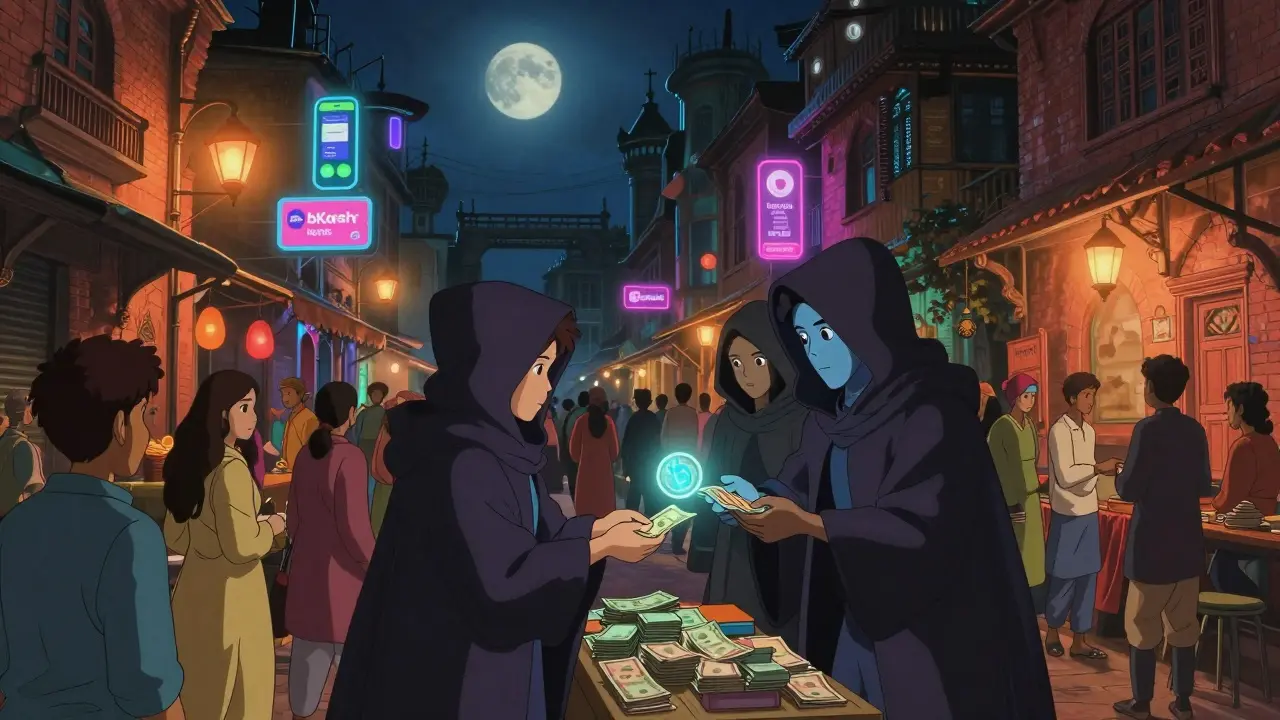
- Fiat Transfer: You transfer Taka via mobile banking apps like bKash or Nagad. These are the lifeblood of this ecosystem, with bKash having over 72 million active users.
- Release: Once the seller confirms receipt of funds, the exchange releases the crypto to your wallet.
This process usually takes 8 to 10 minutes during peak hours. The key advantage is that the exchange acts as a neutral third party, reducing the chance of direct fraud compared to informal deals.
Comparing the Main P2P Methods
Not all P2P trading looks the same. There are three main ways people in Bangladesh handle these transactions, each with distinct pros and cons.
| Method | Market Share | Avg. Spread/Cost | Security Level | Best For |
|---|---|---|---|---|
| Exchange-Based P2P (e.g., Binance) | ~68% | 1.2 - 3.5% | High (Escrow protected) | Most users, beginners |
| Informal Agent Networks | ~20% | 4 - 8% | Low (Trust-based) | Cash-only transactions, anonymity |
| Decentralized Exchanges (DEX) | ~8% | 0.8% + Gas Fees | Medium (Smart Contract risk) | Tech-savvy users, privacy seekers |
1. Centralized Exchange P2P (The Dominant Choice)
Binance dominates this space, holding about 73% of the market share among exchange-based options. It offers 18 fiat payment methods, with bKash used in 61% of transactions. The spread-the difference between the market price and what you pay-is typically 1.2-3.5%. This is often higher than the global spot price because sellers factor in their risk of operating in a restricted jurisdiction.
Bybit is a strong competitor, especially for those interested in margin trading, offering up to 50x leverage. KuCoin is preferred by altcoin enthusiasts due to its wider variety of tradable assets (700+ vs Binance’s 350). However, all these platforms require KYC (Know Your Customer) verification for transactions above $1,000, and none offer direct BDT banking integration.
2. Informal Agent Networks
These are essentially local dealers who act as liquidity providers. They might be mobile financial service agents or individuals found on social media groups. They offer cash-in-hand deals, which appeals to those wary of digital trails. However, the spreads are much higher (4-8%), and the security is minimal. If an agent disappears with your crypto or reverses a bKash payment after receiving coins, you have no platform support to help you. Datawallet reports documented over 12,000 such agents in Dhaka alone in 2023.
3. Decentralized Exchanges (DEX)
For technically proficient users, DEXs like PancakeSwap on the Binance Smart Chain (BSC) offer near-anonymity. You connect a wallet like MetaMask and swap tokens directly. The cost is lower (around 0.8% in fees), but you need to pay gas fees in BNB (averaging $0.15 per transaction). The barrier to entry is high: you need to understand private keys, network congestion, and RPC settings. Only 8% of Bangladeshi traders use this method due to the complexity and higher error rates.
Navigating Technical Hurdles and Mobile Banking
The backbone of P2P trading in Bangladesh is mobile money. With bKash and Nagad having tens of millions of users, they are the primary rails for moving Taka. However, these systems have anti-fraud algorithms that can flag crypto-related transactions.
A common issue is transaction rejection. About 22% of small transactions (under ৳10,000) face rejections on bKash. The workaround, widely shared in community guides, is to use the 'send money' function instead of 'cash in' or 'add money,' as the latter triggers stricter compliance checks. Additionally, transactions above ৳50,000 often fail on Nagad due to automated fraud detection limits.
Device compatibility is another factor. While modern Android devices (8.0+) handle exchange apps smoothly, 42% of traders still use older devices (Android 7.0 or below). This can lead to app crashes or slower performance, especially during peak trading hours (9 AM - 11 PM BST).

Security Risks and How to Mitigate Them
Operating in a legal grey zone means you don’t have consumer protection laws on your side. Scams are prevalent. In 2023, Bangladesh Bank reported 214 fraud cases totaling ৳1.2 billion ($11 million). Here is how to stay safe:
- Stick to Escrow: Never release crypto before confirming the fiat payment has cleared in your bank or mobile wallet. Check your actual balance, not just the notification SMS.
- Check Trader Reputation: On platforms like Binance, look for traders with high completion rates (95%+) and a large number of orders. Avoid new accounts with no history.
- Beware of Chargebacks: Mobile banking payments can sometimes be reversed if the recipient disputes them. Using established merchants with verified badges reduces this risk.
- Use Two-Factor Authentication (2FA): 98% of serious traders use 2FA. Enable it on your exchange account and email immediately.
- Community Verification: Join Telegram groups like 'Crypto BD Guide' (which has over 47,000 members). They maintain blacklists of fraudulent agents. As of 2024, they had blacklisted over 200 bad actors.
Professor Dr. M. Ghazali Kamdi of Dhaka University warned that 78% of P2P trades occur without robust dispute resolution mechanisms outside of the exchange platforms themselves. This makes choosing a reputable exchange critical.
The Future: Regulation and CBDC
The landscape is changing. The government’s National Blockchain Strategy 2023-2027 suggests an interest in blockchain technology, even if speculative trading remains restricted. More significantly, Bangladesh Bank has been developing a Central Bank Digital Currency (CBDC) since 2022. A pilot program involving 500,000 users across 12 districts is expected to yield results in Q3 2025.
If the CBDC succeeds, it could legitimize digital asset infrastructure while keeping private cryptos like Bitcoin restricted. Industry analysts predict a dual-track approach: embracing blockchain for efficiency while maintaining strict controls on decentralized finance. Until clear regulations emerge, likely by 2027, P2P trading will remain the dominant, albeit risky, channel for crypto adoption in Bangladesh.
Is P2P crypto trading legal in Bangladesh?
No, it is not explicitly legal. Bangladesh Bank considers cryptocurrency transactions illegal under the Foreign Exchange Regulation Act 1947. However, enforcement is selective, and millions of users engage in P2P trading despite the ban. Users operate at their own legal risk.
Which P2P platform is best for Bangladeshi users?
Binance is the most popular choice, handling the majority of P2P volume due to its high liquidity, escrow protection, and support for bKash and Nagad. Bybit and KuCoin are alternatives, but Binance offers the deepest market for BDT pairs.
Can I use bKash for crypto P2P trading?
Yes, bKash is the most widely used payment method for P2P crypto trading in Bangladesh. However, transactions may be flagged by anti-fraud systems. It is recommended to use the 'send money' feature and avoid large single transactions to reduce the risk of account freezing.
What are the risks of using informal crypto agents?
The primary risk is fraud. Unlike exchange-based P2P, informal agents do not use escrow services. If an agent takes your money and doesn't send the crypto, or vice versa, you have no platform support to recover your funds. Spreads are also significantly higher (4-8%).
How long does a P2P transaction take?
On average, a P2P transaction on major exchanges like Binance takes 8 to 10 minutes during peak hours. Delays can occur during holidays like Eid when mobile banking systems experience high traffic, potentially extending processing times to 45 minutes or more.
Will Bangladesh legalize cryptocurrency soon?
It is uncertain. A Crypto Asset Task Force was formed in 2025 to study regulations, and a CBDC pilot is underway. Experts predict a regulated framework might emerge by 2027, but currently, speculative crypto trading remains restricted.