22
What is Decentraland (MANA) Crypto Coin? A Simple Guide to the Metaverse Token

Decentraland Land Value Estimator
Estimate potential returns from Decentraland virtual land based on location value, development costs, and revenue streams. This tool uses real-world examples from the article (like $2.4M land sales) to provide realistic scenarios.
Estimated Returns
Break-even Time
Months to cover initial investmentAnnual ROI
Return on investment per year10-Year Value
Estimated value after 10 yearsImportant: This is an estimation tool based on real-world Decentraland examples. Actual returns depend on market conditions, user activity, and the specific location of your LAND. Remember: virtual land value can fluctuate with MANA price and community engagement.
Decentraland isn’t just another cryptocurrency. It’s a fully owned virtual world where you can buy land, build shops, host parties, and earn money-all powered by a token called MANA. If you’ve ever wondered how a digital plot of land can sell for millions, or how people make real money inside a video game, Decentraland is the answer.
What Exactly Is Decentraland?
Decentraland is a blockchain-based virtual reality platform where users own and control the environment. Unlike games like Fortnite or Roblox, where the company owns everything, Decentraland has no boss. No CEO. No corporate headquarters. Instead, it’s run by the people who use it-through votes and token ownership. The platform runs on Ethereum, the same blockchain that powers Bitcoin and many other crypto projects. But instead of just sending money, you’re buying and selling digital real estate, art, clothing for your avatar, and even entire buildings-all stored as NFTs.What Is MANA, and How Does It Work?
MANA is the official currency of Decentraland. Think of it like dollars inside a theme park-but these dollars are real, tradeable, and can be bought on exchanges like Coinbase or Binance. You use MANA to:- Buy virtual land (called LAND NFTs)
- Purchase digital items like hats, cars, or buildings for your space
- Pay for services from other users (like event hosting or design help)
- Vote on platform changes through the Decentraland DAO
LAND: The Digital Real Estate Behind the Token
While MANA is the currency, LAND is the asset. LAND is a non-fungible token (NFT) that represents ownership of a 16x16 meter plot in Decentraland’s virtual world. There are exactly 90,601 plots-no more, no less. Once they’re all sold, that’s it. Some plots are worthless. Others sit near popular areas like the Fashion District or the Casino Zone-and those can sell for hundreds of thousands of dollars. In 2021, a plot near the Genesis Plaza sold for over $2.4 million in ETH. That’s real money, backed by blockchain records. Landowners control everything on their plot. You can turn it into a gallery, a nightclub, a casino, or a store selling NFT art. You can rent it out. You can sell it. You can even charge visitors entry fees using MANA. And because it’s an NFT, you can list it on OpenSea or other marketplaces anytime.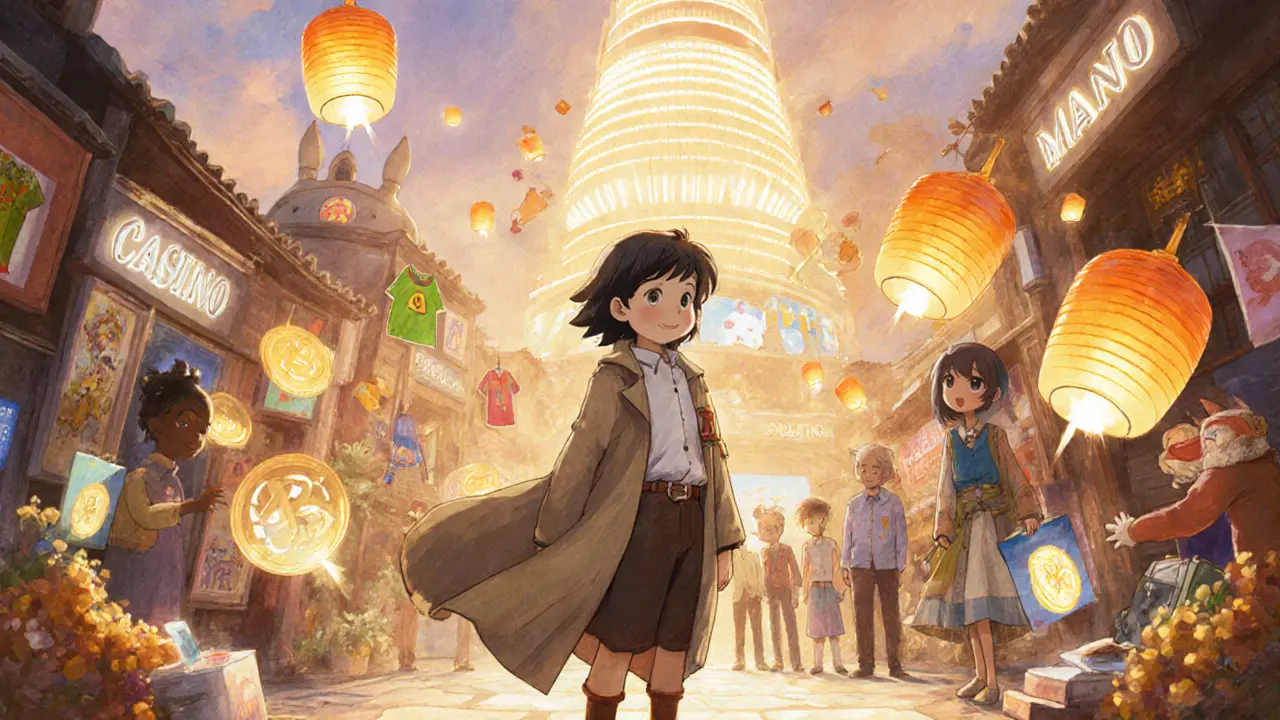
How Is Decentraland Different From Other Virtual Worlds?
Compare Decentraland to Second Life or Roblox. In those platforms, the company owns the servers, the rules, and your assets. If they shut down, your virtual house vanishes. If they change the rules, you lose control. Decentraland is different. Your LAND NFT is yours forever. Even if the Decentraland website goes down, your land still exists on the Ethereum blockchain. You can still access it through other tools. You can still sell it. You can still prove you own it. The platform also uses a DAO-Decentralized Autonomous Organization-to make decisions. Anyone holding MANA can submit proposals. Want to change how land auctions work? Add a new feature? Fund a public park? You vote with your tokens. The more MANA you have, the more weight your vote carries. No board of directors. No hidden agendas. Just community-driven upgrades.How Do You Make Money in Decentraland?
People earn MANA in several ways:- Buying and selling LAND: Buy low, sell high. Some investors treat it like real estate speculation.
- Creating experiences: Build a game, a concert venue, or a museum. Charge visitors MANA to enter or tip you.
- Staking MANA: Lock your tokens into "land pools" to earn a share of revenue from activities on that land.
- Hosting events: Brands like Samsung, Atari, and Sotheby’s have hosted virtual events in Decentraland, paying creators to run them.
- Designing assets: Create clothing, furniture, or animations and sell them on the Decentraland marketplace.
How Do You Get Started?
You don’t need fancy gear. You can access Decentraland through any modern web browser on your laptop or phone. VR headsets make it more immersive, but they’re optional. Here’s how to begin:- Get an Ethereum wallet (MetaMask is the most popular).
- Buy some ETH from an exchange like Coinbase or Kraken.
- Swap ETH for MANA on a decentralized exchange like Uniswap.
- Visit decentraland.org and connect your wallet.
- Explore the world, buy LAND, or start creating.
What’s the Future of Decentraland?
The platform launched in 2017 and raised $26 million in its first token sale. Since then, it’s grown into one of the most active metaverse ecosystems. Major brands use it for marketing. Artists sell NFTs there. Musicians host live shows. The Decentraland team destroyed the private key that once controlled its core smart contracts. That means even the original creators can’t change the rules. The system runs on code-and the community. But it’s not without risk. Crypto markets are volatile. MANA’s price swings with Bitcoin and Ethereum. Virtual land isn’t guaranteed to appreciate. And if no one shows up to your virtual club, you won’t earn anything. Still, Decentraland represents something new: true digital ownership. For the first time, people aren’t just playing in a game-they’re building economies, owning assets, and shaping worlds.Is MANA a Good Investment?
It depends on what you’re looking for. If you want to speculate on crypto prices, MANA has seen big ups and downs. It peaked near $5 in 2021 and dropped below $0.30 in 2022. As of late 2025, it trades around $0.45. But if you’re interested in owning part of a growing virtual economy-where land, creativity, and community drive value-then MANA gives you a stake in that future. Think of it less like buying a stock and more like buying a piece of digital real estate in a city that’s still being built. Some plots will fail. Others will become landmarks. The key is to understand the system before you invest.What Happens If the Platform Fails?
Even if Decentraland’s website disappears tomorrow, your LAND NFT and MANA tokens still exist on Ethereum. You can still trade them. You can still use them in other apps that support ERC-20 and ERC-721 tokens. The real value isn’t in the Decentraland website-it’s in the blockchain records that prove you own something. That’s the power of decentralization.Can I use MANA to buy things outside of Decentraland?
Yes. MANA is listed on major exchanges like Binance, Coinbase, and Kraken, so you can trade it for other cryptocurrencies or cash out to fiat currency. It’s also accepted on some NFT marketplaces and decentralized apps (dApps) that integrate with Decentraland’s ecosystem.
Do I need VR to use Decentraland?
No. You can access Decentraland through a web browser on your computer or phone. VR headsets like Meta Quest or HTC Vive enhance the experience by making it feel more immersive, but they’re not required to explore, buy land, or create content.
How is MANA different from other metaverse tokens like SAND?
MANA powers Decentraland, which is built entirely on Ethereum and focuses on user-owned virtual real estate. SAND runs The Sandbox, which is more game-focused and allows users to create and monetize games. Both use NFTs and DAOs, but Decentraland emphasizes digital land ownership, while The Sandbox leans into game creation tools.
Can I lose my LAND if I don’t pay fees?
No. Unlike traditional property taxes, Decentraland doesn’t charge recurring fees to keep your LAND. Once you own it, it’s yours forever-unless you sell it or lose access to your wallet. That’s why many people treat it like digital real estate with no maintenance costs.
Is Decentraland safe from hackers?
The platform’s smart contracts have been audited and are built on Ethereum, one of the most secure blockchains. But your personal wallet is your responsibility. If you lose your private key or fall for a phishing scam, you can lose your MANA or LAND. Never share your seed phrase, and use hardware wallets for large holdings.
Decentraland isn’t a game. It’s a new kind of economy-one where your digital actions have real value. Whether you’re a developer, an investor, or just curious, it’s worth exploring. The virtual world is being built right now-and you can own a piece of it.


Jane A
November 22, 2025 AT 08:06This is just digital pyramid scheme with fancy graphics. People paying millions for pixels? LOL. Next they'll sell air in VR and call it NFT real estate. Wake up people, this ain't wealth-it's hype with a blockchain sticker.
And don't get me started on 'ownership'-you don't own anything if the website shuts down. You just own a string of code that's useless without the platform.
Someone's making bank off your FOMO. That's it.
jocelyn cortez
November 23, 2025 AT 04:36i just visited decentraland last week. wandered around for an hour. saw a virtual art gallery, some music thing, a few shops. it felt... quiet. like an empty mall on a tuesday. no one was there.
the tech works, sure. but who's actually using it? i think most of the 'activity' is bots and investors flipping land.
kinda sad, honestly. the dream was cool. the reality feels lonely.
Gus Mitchener
November 23, 2025 AT 07:57Decentraland represents a paradigmatic shift in the ontological architecture of digital property relations. The ERC-721 tokenization of spatial coordinates within a distributed ledger enables non-sovereign, non-custodial ownership-a radical departure from the centralized feudalism of Web2 virtual worlds.
MANA functions as a governance token within a sybil-resistant DAO, wherein voting power is proportional to stake, not identity. This introduces a novel form of algorithmic democracy, where consensus is enforced through cryptographic commitment rather than institutional authority.
The real innovation isn't the metaverse-it's the inversion of rent-seeking. Land isn't leased from a corporation; it's owned by the user, and its value emerges from emergent social coordination, not corporate fiat.
When you consider that Ethereum's base layer provides immutable provenance, you realize this isn't gaming-it's post-capitalist spatial economics in action.
Whether it scales is another question-but the architecture? Brilliant. The vaporware narrative is a red herring.
Jennifer Morton-Riggs
November 24, 2025 AT 04:07okay but like… if i buy land in decentraland and then the whole thing crashes because crypto dies or whatever, am i just left with a bunch of nfts that no one cares about?
it’s not like i can print out my plot and hang it on the wall. it’s just… data. in a wallet. that might disappear.
and don’t even get me started on the gas fees. i tried to buy a hat once and got charged $40 in eth just to click ‘buy’.
so yeah. cool idea. but i’m not spending my money on digital sandcastles.
also, why does everyone act like this is the future? it feels like 2017 all over again with crypto bros screaming ‘this changes everything’ while their wallets slowly bleed.
Tejas Kansara
November 24, 2025 AT 09:52Land prices are insane. But if you build something useful-like a real event space or a learning hub-it can work.
I know someone who hosted coding workshops there. Got paid in MANA. Now he teaches in VR full-time.
It’s not magic. But it’s real if you put in the work.
Lisa Hubbard
November 25, 2025 AT 08:32Look, I read the whole thing. Twice. I even watched a YouTube video about it. And I still don’t get it. Why would anyone pay millions for digital dirt? What’s the point? I mean, sure, I can put a virtual painting on my plot, but then what? Do I invite my friends over? Do we sit in chairs that don’t exist? Do we pretend the music is real?
It’s like buying a painting that only you can see, and then telling everyone it’s worth $2 million because you say so.
And don’t even get me started on the DAO. Who even votes on this stuff? The same 50 people who own 80% of the MANA? So it’s not decentralized at all-it’s just oligarchic with more buzzwords.
I’m not mad. I’m just… confused. Like, why are we doing this? Is this progress? Or just a really expensive art project for rich guys with too much time?
Belle Bormann
November 26, 2025 AT 16:44you dont need vr to use it but i reccomend it if you can. its way better. i got a quest 3 and its mind blowing. i bought a tiny plot and turned it into a little cafe with music and books. people actually come by and chat. its weirdly nice.
also, if you want to buy land, wait for a sale. the prices drop sometimes. i got mine for 1.2 eth when everyone was panicking. now its worth 2.5. not rich, but not bad.
and yes, you can sell your stuff on opensea. just make sure your wallet is secure. i lost a friend's nft once because he clicked a dodgy link. dont be him.
preet kaur
November 27, 2025 AT 03:55in india, most people think this is just a scam. but i’ve seen kids in small towns using decentraland to learn digital design. they make assets, sell them, earn MANA, then convert to rupees.
it’s not about the land. it’s about the skill. the platform gives them a global stage.
maybe it’s not for everyone. but for someone with no access to traditional creative jobs? this is a door.
don’t laugh at the dream. sometimes the weirdest dreams become someone’s lifeline.
Emily Michaelson
November 27, 2025 AT 11:28i think people miss the point. it’s not about the price of land or the price of mana.
it’s about what happens when you remove the middleman. no corporate owner. no takedown notices. no ‘we own your content’ clauses.
if you build something beautiful, it stays yours. forever.
that’s powerful. even if only 1% of users ever use it meaningfully, it’s still a prototype for something better.
we’re still figuring this out. but the direction? i believe in it.
John Borwick
November 28, 2025 AT 22:25my buddy bought land near the casino zone last year. he built a virtual jazz bar. hired a dj. started charging entry in mana.
first month: 3 visitors. second month: 12. third month: 80. now he’s got weekly events. people fly in from europe just to hang out.
it’s not about the money. it’s about community.
you can’t replicate that in a zoom call.
and yeah, the tech is clunky. the UI is messy. but when you walk in and hear live saxophone echoing through a digital room? it hits different.
the future isn’t perfect. but it’s real.
and it’s already happening.
Linda English
November 29, 2025 AT 15:11I just want to say-I really appreciate how thoughtful this post was. It didn’t just throw out buzzwords. It actually explained the mechanics, the risks, the emotional weight behind digital ownership.
It’s easy to dismiss this as a crypto fad, but I think we’re standing at the edge of something profound-something that redefines what it means to own, create, and belong in a digital space.
And yes, there are scams. Yes, there’s volatility. Yes, it’s still experimental.
But I think the fact that someone, somewhere, is building a virtual library for blind children using MANA and NFT art-that’s the kind of thing that makes all the noise worth it.
I’m not investing. I’m just… watching. And hoping.
Thank you for writing this.
It helped me understand.
And that’s rare.
asher malik
November 29, 2025 AT 22:33man i just sat here for 20 minutes thinking about this
like what if we’re not building a metaverse
what if we’re just building a new kind of capitalism
with better graphics
and more buzzwords
and the same old winners
and the same old losers
and the same old people selling dreams to people who need hope
it’s not evil
but it’s not magic either
it’s just… human
again
again
again
Tyler Boyle
November 30, 2025 AT 05:11Okay, so let me get this straight. You’re telling me that I can spend $2 million on a square of pixels in a game that doesn’t even have decent graphics, and somehow that’s ‘digital real estate’?
Meanwhile, my actual house has a leaky roof, a broken AC, and a mortgage, and I can’t even afford to fix it.
And you want me to believe that this is the future of wealth?
Let me tell you something-this isn’t innovation. This is delusion dressed up in blockchain jargon.
And the fact that people are actually doing this? That’s the saddest part.
People are trading their real-world stability for a fantasy where the only thing that matters is who has the biggest wallet.
And the worst part? The people who built this? They already cashed out.
They’re laughing all the way to the bank while you’re trying to figure out how to sell your virtual hat.
Wake up.
It’s not a revolution.
It’s a pyramid.
With better lighting.