1
What is Open Exchange Token (OX) crypto coin? Full breakdown of its price, utility, and risks

The Open Exchange Token, or OX, is a cryptocurrency built to power the Open Exchange (OPNX) platform - a crypto trading platform that lets users trade spot assets, derivatives, and claims on public orderbooks. But unlike popular exchange tokens like BNB or OKB, OX hasn’t gained traction. In fact, most of its story is one of steep decline, low volume, and questionable reliability.
Launched on May 29, 2023, OX is an ERC-20 token running on the Ethereum blockchain. Its contract address is 0x78a0a62fba6fb21a83fe8a3433d44c73a4017a6f, and it has a maximum supply of 9.86 billion tokens. That’s a lot. But here’s the problem: over 5.6 billion are already in circulation - meaning more than half the total supply is out there, yet almost no one is trading it.
How OX is supposed to work
OX was designed as a utility token for the OPNX exchange. That means you’re meant to use it to pay trading fees, earn discounts, or participate in platform governance. In theory, it’s similar to Binance’s BNB or Coinbase’s HBTC - tokens tied directly to the exchange you’re using.
But unlike BNB, which powers a $94 billion ecosystem, OX supports a platform with negligible volume. According to Coinbase data, the 24-hour trading volume for all OX pairs combined is around $70,320. That’s less than what a single popular meme coin trades in an hour. For comparison, BNB alone sees over $1.2 billion in daily volume.
OPNX markets itself as the first exchange to let users trade claims on public orderbooks - a fancy way of saying it lets you copy trades from other platforms. But the lack of real users makes this feature meaningless. If no one’s trading, there’s nothing to copy.
Price history: From $0.08 to $0.0001
OX hit its all-time high of $0.0812 on August 9, 2023. That was it. Since then, it’s been a freefall.
As of March 2026, OX trades around $0.00013 - a 99% drop from its peak. Some sources say it’s even lower. SwapSpace reports $0.000128, while CoinLore lists $0.000769. The inconsistency alone should raise red flags. When different data providers can’t agree on the price, you’re dealing with a token that’s barely being traded.
Even worse, the token’s performance against other assets is brutal. Over the past year, OX lost:
- 82.55% against the US dollar
- 89.77% against Bitcoin
- 88.61% against Ethereum
That’s not underperformance. That’s obliteration.
Why the price keeps crashing
There are three big reasons OX has failed:
- No real demand - People aren’t using OX for anything practical. You can’t pay bills with it. You can’t stake it meaningfully. You can’t earn interest on it. It only exists to trade on OPNX - and OPNX has almost no users.
- Massive supply, zero activity - With over 5.6 billion tokens circulating, you’d expect some buying pressure. But trading volume is so low that even small sells cause big price drops. This makes OX extremely volatile - and dangerous.
- Weak platform - OPNX has a Trustpilot rating of 1.7 out of 5. Users complain about withdrawal delays, poor customer service, and outdated documentation. If the exchange is broken, the token tied to it won’t survive.
Reddit users call OX “another dead exchange token.” One person wrote: “Bought the hype at $0.05 in 2023. Now it’s worth pennies. Classic dump.” That sentiment is repeated across forums.
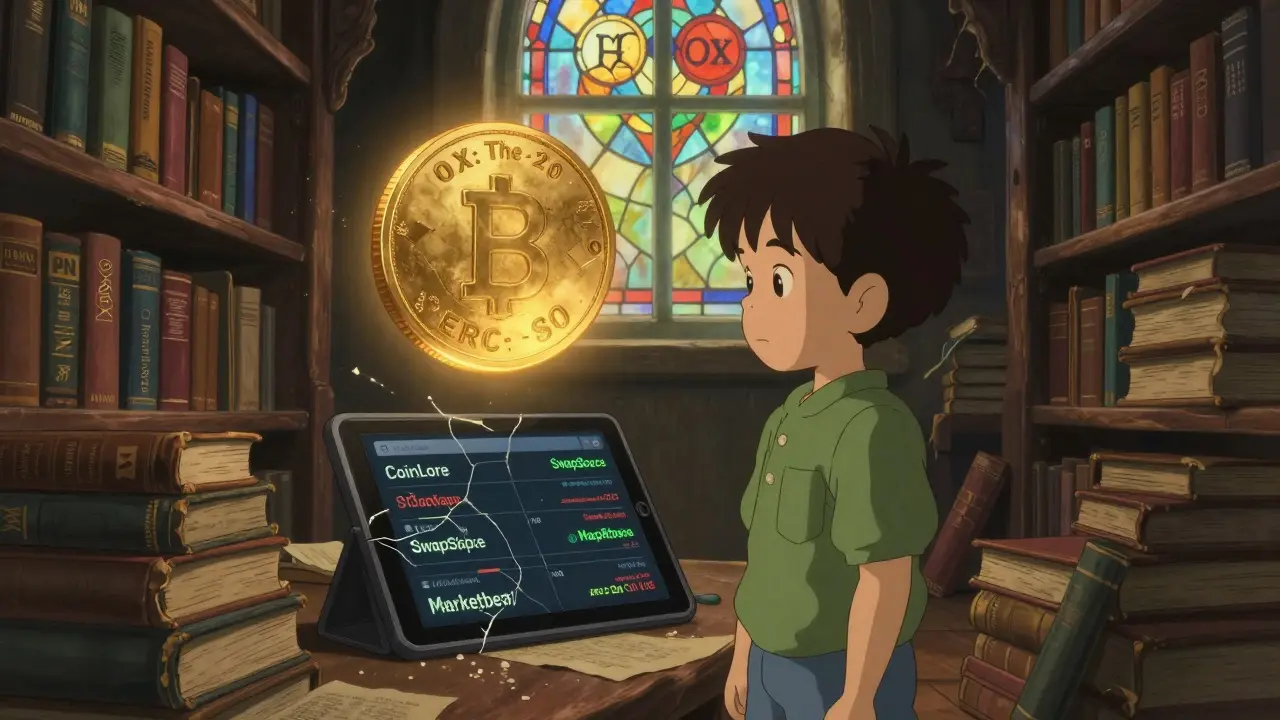
Market data: Who’s lying?
Here’s where things get messy. Different sites report wildly different numbers:
- CoinLore: $4.6 million market cap, $0.000769 price
- Marketbeat: $113 million market cap (unverified)
- SwapSpace: $0.000128 price, $720,000 market cap
- Etherscan: $5.16 million market cap
That’s a 25x difference between the lowest and highest estimates. That kind of inconsistency doesn’t happen with legitimate projects. It suggests either:
- One or more data providers are wrong
- There’s manipulation - fake volume or inflated market cap claims
- Or, most likely, no one is trading it seriously
Experts treat this as a major red flag. If you can’t trust the numbers, you can’t trust the asset.
Can you still use OX?
Technically, yes. OX is an ERC-20 token, so you can store it in any Ethereum wallet like MetaMask or Trust Wallet. You can also trade it on Coinbase, though the liquidity is terrible. Trying to buy $1,000 worth of OX could move the price by 20% or more.
There’s no staking, no yield, no rewards program. No partnerships with other platforms. No roadmap updates since 2023. The contract hasn’t changed. The team hasn’t posted anything meaningful in over a year.
If you’re thinking of buying OX, you’re not investing in a project. You’re gambling on a dead token that might, just might, get a pump from a random tweet or a short-term speculative spike.

What do experts say?
PricePrediction.net calls OX “a poor investment.” SwapSpace’s model predicts it could drop as low as $0.0000286 by 2026 - another 78% down from current levels. Coinbase’s analysis shows OX is trading at 99% below its all-time high, placing it among the worst-performing tokens in crypto history.
There’s no bullish case. No upcoming upgrade. No institutional interest. No regulatory approval. No real use case beyond speculation.
Final verdict: Is OX worth anything?
No. Not as an investment. Not as a utility token. Not even as a curiosity.
OX is a cautionary tale. It was launched with ambition - to build a transparent, accessible financial platform. But it failed at the most basic level: attracting users.
While tokens like BNB and SOL power massive ecosystems, OX sits in the shadows with almost no volume, no community, and no future. If you already own it, you’re holding a token that’s lost 99% of its value. If you’re thinking of buying it, you’re risking money on a project that’s already dead.
The only thing OX is good for right now is teaching people how not to invest in crypto.
Is Open Exchange Token (OX) a good investment?
No. OX has lost over 99% of its value since its all-time high in August 2023. It has extremely low trading volume, no real utility, and is tied to a poorly rated exchange. Experts and price prediction models consistently label it a poor investment with high risk of further decline.
Where can I buy Open Exchange Token (OX)?
OX is listed on Coinbase and a few smaller exchanges. However, trading volume is extremely low - around $70,000 per day across all pairs. This means large trades can cause massive price swings, making it risky to buy or sell.
What is the current price of OX?
As of March 2026, OX trades between $0.00012 and $0.00077 depending on the data source. This inconsistency suggests minimal trading activity and unreliable market data. The most consistent price across platforms is around $0.00013.
Can I stake or earn interest on OX?
No. There are no staking programs, yield farms, or interest-bearing options for OX. It has no passive income features. Its only function is speculative trading on the OPNX exchange.
Why is OX’s market cap so inconsistent across websites?
The inconsistency comes from extremely low trading volume and lack of real market activity. Some sites may be using outdated or inflated data. Marketbeat claims a $113 million market cap, but CoinLore and Etherscan show under $6 million. This gap suggests potential data manipulation or simply no meaningful trading occurring.
Is OX tied to any major exchange like Binance or Coinbase?
OX is tied to OPNX, a small, independent exchange with minimal users and poor reviews. Unlike Binance (which uses BNB) or Coinbase (which uses HBTC), OPNX is not a major player. OX has no partnerships, no institutional backing, and no regulatory recognition.
What’s the total supply of OX?
The maximum supply of OX is 9,860,000,000 tokens. As of March 2026, over 5.6 billion are in circulation - more than half the total supply. This large circulating supply, combined with minimal trading, makes it difficult for the price to rise.
Can OX be used to pay for trading fees on OPNX?
Yes, according to OPNX’s documentation, OX can be used to pay trading fees and receive discounts. But since the platform has almost no users, this feature is irrelevant. No one is trading enough to benefit from the discount, and the token’s value is too unstable to rely on.
Is OX safe to store in MetaMask?
Yes. OX is an ERC-20 token, so it’s fully compatible with MetaMask, Trust Wallet, and other Ethereum-compatible wallets. However, storing it doesn’t make it safer or more valuable. The risk isn’t in the wallet - it’s in the token itself.
Has OX been flagged by regulators?
As of March 2026, OX has not been officially flagged by the SEC or other major regulators. However, because it’s listed on Coinbase - a U.S.-regulated exchange - it may be under indirect scrutiny. The lack of transparency around its supply and trading volume increases regulatory risk.









Lucy Simmonds
March 2, 2026 AT 08:07Samantha Stultz
March 3, 2026 AT 12:25Robert Conmy
March 5, 2026 AT 08:19Lilly Markou
March 7, 2026 AT 00:47McKenna Becker
March 8, 2026 AT 03:09Phillip Marson
March 8, 2026 AT 03:21Ryan Burk
March 10, 2026 AT 00:35Amanda Markwick
March 10, 2026 AT 15:14Tabitha Davis
March 10, 2026 AT 19:22Vishakha Singh
March 11, 2026 AT 12:34Don B.
March 11, 2026 AT 20:36Leslie Cox
March 12, 2026 AT 19:40Derek Sasser
March 14, 2026 AT 07:29Fiona Monroe
March 16, 2026 AT 06:24Molley Spencer
March 16, 2026 AT 18:11John Fuller
March 17, 2026 AT 05:30Maggie House
March 18, 2026 AT 08:20Dana Sikand
March 19, 2026 AT 07:36Cameron Pearce Macfarlane
March 20, 2026 AT 21:00Elizabeth Smith
March 22, 2026 AT 13:33Robert Kromberg
March 24, 2026 AT 02:57Daisy Boliaan
March 25, 2026 AT 00:47Nicki Casey
March 25, 2026 AT 17:59