23
DEX Security: Risks and Protections in Decentralized Trading
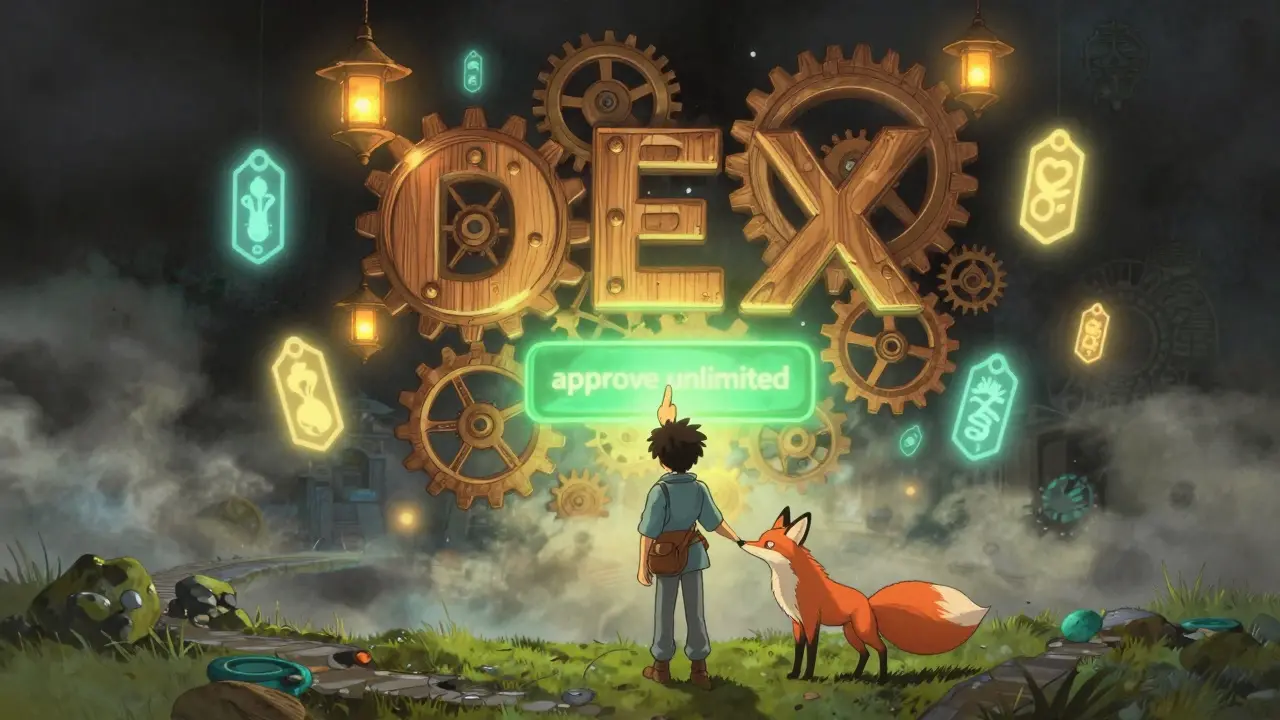
When you trade crypto on a decentralized exchange (DEX), no company holds your money. No customer support line. No password reset. Just you, your wallet, and a piece of code running on a blockchain. That’s the promise - and the peril. DEXs like Uniswap, PancakeSwap, and Curve have processed over $1.37 trillion in trades in Q1 2025 alone. But behind every smooth trade is a minefield of risks most users never see coming.
How DEXs Work (And Why They’re So Risky)
Unlike centralized exchanges like Binance or Coinbase, DEXs don’t store your funds. Instead, they use smart contracts - self-executing code on blockchains - to match trades directly between wallets. Liquidity pools, funded by users who deposit pairs of tokens, act as the market. When you swap ETH for USDC, you’re not trading with another person. You’re trading against a pool of coins locked in code.
This removes counterparty risk. No exchange gets hacked. No insider steals your balance. But it shifts all the risk onto you. If the code has a flaw, if you click the wrong button, or if a fake token tricks your wallet, your money is gone - forever. There’s no undo button on blockchain.
The Top 5 DEX Security Risks You Can’t Ignore
- Smart Contract Bugs: Even audited contracts can hide fatal flaws. In 2024, $1.48 billion was lost to DeFi exploits, and 63.2% of those came from code vulnerabilities. A single line of bad logic can let attackers drain pools. Uniswap v3’s code was audited, yet a 2024 bug in a third-party liquidity provider caused a $42 million loss.
- Infinite Token Approvals: This is the #1 cause of user losses. When you first connect your wallet to a DEX, it asks for permission to spend your tokens. Many users click "approve unlimited" without thinking. Later, a malicious contract can drain every token you own - even ones you never traded. Over 19% of users accidentally grant this permission, according to Cyvers’ 2025 survey.
- Slippage Manipulation: Slippage is the difference between the price you see and the price you get. DEXs let you set a max slippage tolerance - usually 0.5% to 5%. Attackers exploit high slippage settings by flooding a pool with fake trades, pushing prices wildly off-course. A user who set 10% slippage on a low-volume token lost $8,450 in one transaction because the price dropped 18% mid-swap.
- Fake DEX Websites and Scam Tokens: Google a DEX name and you’ll get dozens of clones. Fake Uniswap sites look identical. They copy the UI, the logo, even the contract address. Once you connect your wallet, they steal your private keys or trick you into approving infinite access. Scam tokens? They’re often named like real ones - "BUSD", "ETH", "USDT" - but with slight spelling changes. One user lost $12,000 swapping "ETH" for "ETh" on a fake site.
- Oracle Manipulation: DEXs need real-time price data to function. Most use oracles like Chainlink or Pyth. But if an attacker floods a market with fake trades, they can trick the oracle into reporting a false price. That’s how the $7.3 million Jupiter Aggregator exploit happened on Solana in February 2025. The oracle thought a token was worth $100 - it was actually worth $0.10.
How DEXs Try to Protect Themselves (And You)
DEX teams aren’t sitting idle. Most top platforms now use layered security:
- Timelock Contracts: 92.3% of major DEXs delay critical changes (like changing fees or pausing trading) for 48-72 hours. This gives the community time to spot bad code before it goes live.
- Circuit Breakers: If a token’s price swings more than 15% in 30 seconds, trading halts automatically. This stopped a potential $200 million loss during a flash crash on Curve Finance in April 2025.
- Multi-Sig Governance: Instead of one person controlling the code, 5-7 key holders must approve changes. This reduces the chance of insider theft or accidental updates.
- Bug Bounties: Projects now offer cash rewards for finding flaws. Ethereum’s major DEXs have collectively paid out $147 million in bounties since 2020. That’s led to a 90% drop in exploit severity, according to Vitalik Buterin.
- Wallet Guardrails: Tools like Revoke.cash let you see which contracts have access to your tokens - and instantly revoke permissions. 28.7% of experienced users use this daily.

What You Can Do to Stay Safe
Security isn’t just the DEX’s job. You’re the last line of defense.
- Never approve unlimited token access. Always set limits. If a DEX asks for "unlimited," cancel it. Use Revoke.cash to check and clean up old approvals.
- Set slippage to 0.5% or lower. If a trade requires more than 1% slippage, walk away. That’s a red flag.
- Double-check contract addresses. Always verify the official DEX website. Bookmark it. Never click links from Twitter, Telegram, or Reddit.
- Use DEX aggregators with built-in checks. Platforms like 1inch and Matcha scan for scams and compare prices across 14+ DEXs. They reduce slippage and flag fake tokens.
- Use a hardware wallet. If you’re trading more than $1,000, store your keys in a Ledger or Trezor. Software wallets like MetaMask are convenient - but vulnerable to malware.
- Test with small amounts first. Try a $5 swap before moving $500. If something feels off, stop.
The Big Contradiction: Decentralization vs. Centralized Dependencies
Here’s the irony: DEXs claim to be fully decentralized. But 73.2% of them rely on Chainlink or Pyth for price data. If those oracles go down, or get hacked, the whole DEX ecosystem stumbles. The Financial Stability Board warned in late 2024 that this creates a single point of failure - the opposite of decentralization.
And while DEXs don’t require KYC, 67.3% of new platforms now offer optional identity verification. Why? Because regulators are closing in. The EU’s MiCA law now requires DEXs serving EU users to collect basic ID info by June 30, 2025. The SEC’s April 2025 guidance says if a DEX has centralized governance (like a team that can change code), it must register as an exchange.
So DEXs are becoming more regulated - not less. The dream of a completely lawless financial system is fading. The future is hybrid: decentralized tech, with centralized oversight.

Real User Stories: The Good, The Bad, The Ugly
One Reddit user, u/DeFiWarrior2025, posted: "I lost $14,000 because I didn’t check the token contract. It looked like USDC, but it was a scam. My wallet showed 100 USDC - I traded it for ETH. Turns out, it was a token with 18 decimals. I gave away $14K thinking I gave away $14."
Another, from a Georgia Tech study, said: "I spent 8 hours learning how to use Uniswap. First trade failed because I didn’t set gas right. Second failed because I approved infinite access. Third worked. Now I use Revoke.cash every week. I’ve made 14.2% APY on stablecoin pools. Worth the learning curve."
Meanwhile, a 2025 Trustpilot review from a user named "CryptoMom" reads: "My 16-year-old tried to swap Solana for USDT. He clicked "approve" on a popup. We lost $8,450. No one helped us. No refund. No support. Just a blockchain. We’re done with DEXs."
The Future: Safer, Smarter, But Still Dangerous
The good news? Exploits are dropping. In 2024, $1.48 billion was lost. In 2023, it was $2.1 billion. That’s a 37.2% drop - thanks to better audits, bug bounties, and user education. Cybersecurity insurance for DEXs jumped from 12% to 49% in just one year.
Upgrades like Ethereum’s Pectra (May 2025) and Uniswap v4 (coming Q3 2025) will let users set custom security rules - like auto-revoking permissions after 24 hours. Cross-chain security tools like Chainlink’s CCIP will let funds move safely between blockchains without trusting intermediaries.
But here’s the truth: DEXs will never be as easy as PayPal. They’re not meant to be. They’re tools for people who want control - and are willing to learn the risks. If you treat them like a bank, you’ll lose money. If you treat them like a power tool - respect them, learn them, protect yourself - they can work wonders.
Are DEXs safer than centralized exchanges?
It depends on what you’re worried about. DEXs are safer from hacks because they don’t hold your funds - no centralized database to break into. In 2024, CEXs lost $427 million to breaches, while DEXs lost $1.48 billion - but almost all of that came from user error or smart contract bugs, not exchange theft. So if you’re scared of an exchange getting hacked, DEXs win. If you’re scared of making a mistake, DEXs are riskier.
Can I get my money back if I get scammed on a DEX?
No. Blockchain transactions are irreversible by design. Once you send crypto, it’s gone. There’s no chargeback, no refund, no customer service. That’s why prevention is everything. Always verify contracts, set low slippage, and never approve unlimited access. If you’ve already been scammed, tools like Revoke.cash can stop further losses - but they can’t recover what’s already gone.
What’s the best wallet to use with DEXs?
For beginners, MetaMask (on desktop or mobile) is the most popular and easiest to use. For serious traders or large holdings, use a hardware wallet like Ledger or Trezor connected to MetaMask. Hardware wallets keep your private keys offline, making them immune to malware. Never use a wallet you downloaded from a random link. Only use official versions from the developer’s website.
Why do DEXs have so many different token prices?
Liquidity is fragmented. Each DEX has its own pool of tokens. If one DEX has 100 ETH and 50,000 USDC, and another has 50 ETH and 48,000 USDC, the price will differ. That’s why prices vary by 2.3% to 4.7% across DEXs - versus under 0.3% on centralized exchanges. DEX aggregators like 1inch solve this by finding the best price across all platforms.
Should I use a DEX aggregator?
Yes - especially if you’re new. Aggregators like 1inch, Matcha, and Paraswap scan dozens of DEXs to find the best rate and lowest slippage. They also include built-in scam detection and auto-revoke features. They don’t eliminate risk, but they reduce it significantly. Always check which DEXs they’re using - stick to well-known ones like Uniswap or SushiSwap, not obscure pools.









Kristi Emens
February 24, 2026 AT 19:25DEXs are a double-edged sword. On one hand, you have full control. On the other, you’re the entire security team, customer service, and compliance officer rolled into one. I’ve seen too many people lose money because they trusted a popup that looked legit. The real lesson isn’t about smart contracts-it’s about humility. If you don’t understand what you’re approving, don’t click.
Deborah Robinson
February 26, 2026 AT 11:37Just want to say-Revoke.cash is a game changer. I used to have infinite approvals on like 12 different tokens. Didn’t even know. Now I check it every Sunday morning with coffee. Took me 3 minutes. Saved me from a potential $20k loss last month. Seriously, if you’re on a DEX and not using this tool, you’re playing Russian roulette.
Michelle Mitchell
February 27, 2026 AT 17:39so like… dexes are just… crypto casinos with extra steps? i mean, if you lose money because you clicked approve on a fake token… is that your fault or is the system just designed to eat dumb people? also why do they even let people use this stuff without a permit? like, you need a license to drive a car. but you can blow your life savings on a coin called "ETh"? 🤔
Kaitlyn Clark
February 28, 2026 AT 13:27STOP acting like DEXs are "just for experts". That’s a lie. They’re designed to be dangerous. Why? Because if you make it hard, people think it’s "decentralized" and feel smart. Meanwhile, 80% of users are getting rekt by slippage traps and fake interfaces. The devs know this. They don’t fix it because scared users keep trading. It’s a feature, not a bug. Use a hardware wallet. Set slippage to 0.1%. And stop trusting anything that says "Uniswap" unless you typed the URL yourself.
christopher luke
March 2, 2026 AT 00:15I’ve been using DEXs since 2021 and lost less than $200 total. The key? Small trades. Always. I started with $5. Then $20. Then $100. Now I’m up 3x. It’s not about being smart-it’s about being patient. And yes, I use Revoke.cash. And yes, I use Ledger. And no, I don’t click "approve unlimited". It’s not magic. It’s discipline.
Mary Scott
March 2, 2026 AT 06:26Chainlink is centralized. Pyth is centralized. The whole system is a house of cards built on Oracle giants. And you call this decentralization? The EU is forcing KYC on DEXs because they know this. It’s all a scam. They want you to think you’re free, but you’re just trading inside a walled garden owned by a few tech firms. Wake up.
Shannon Holliday
March 3, 2026 AT 06:47My cousin in Manila lost $18k on a fake PancakeSwap site. He thought it was real because the logo was the same. I showed him how to check the contract address. He’s still scared. But now he uses 1inch and only swaps under $50. Progress. Not perfect. But progress. 🙏
Jeremy buttoncollector
March 3, 2026 AT 16:20The ontological paradox of DEX security lies in its epistemological dependency on centralized infrastructure. The very mechanisms designed to enforce decentralization-oracle feeds, governance contracts, liquidity bootstrapping-are all tethered to centralized nodes. Thus, the ideological purity of self-custody is undermined by the pragmatic necessity of centralized trust anchors. Ergo, we are not sovereign. We are merely custodians of a distributed illusion.
Michelle Xu
March 4, 2026 AT 04:12One thing I’ve learned from working in fintech: the most secure systems aren’t the most complex. They’re the ones that make it easy to do the right thing. DEXs still make it too easy to do the wrong thing. That’s not a user problem-it’s a design failure. Tools like Revoke.cash and 1inch help, but they’re band-aids. What we need is default-safe interfaces: unlimited approvals blocked by default, slippage capped at 0.5%, contract verification built into every swap button. Until then, we’re all just playing defense.
Ryan Burk
March 5, 2026 AT 16:59Everyone’s acting like DEXs are some kind of frontier. Nah. They’re just the Wild West with more gas fees. And guess who gets shot? The people who think "I’m tech-savvy". You don’t get to be a crypto hero because you used MetaMask. You get to be a statistic because you approved a token called "USDC" that had 18 decimals. Stop glorifying ignorance. This isn’t innovation-it’s exploitation dressed up as freedom.
Amanda Markwick
March 6, 2026 AT 19:29I love how much we’ve improved since 2021. Back then, you’d lose money because you didn’t know what a gas fee was. Now, we have wallet guardrails, aggregators, audits, bug bounties, and even insurance. Yes, there are still risks. But the drop in exploit losses-from $2.1B to $1.48B-is real. We’re learning. We’re adapting. The tools are getting better. The users are getting smarter. It’s not perfect. But it’s moving forward. Don’t give up because of one bad trade. Learn. Adjust. Try again.
Sriharsha Majety
March 7, 2026 AT 16:48i never knew about revoke.cash until last week. i had like 50 tokens approved and i thought it was normal. now i clean it every month. its like digital housekeeping. small habit. big difference. thanks to everyone who shared this. i feel less scared now
Tabitha Davis
March 8, 2026 AT 19:19Y’all are missing the point. DEXs aren’t dangerous because of smart contracts. They’re dangerous because they’re a Trojan horse for institutional control. The "bug bounties"? Paid by VC-backed teams. The "circuit breakers"? Designed by ex-Binance engineers. The "wallet guardrails"? Built by companies that want you to stay inside their walled garden. This isn’t decentralization. It’s rebranding. The real enemy isn’t scammers-it’s the narrative that this is freedom.
Vishakha Singh
March 9, 2026 AT 13:08As someone who teaches blockchain basics to college students in India, I can confirm: the biggest barrier isn’t technology-it’s confidence. Many think they’re not "smart enough" for DEXs. But the truth? You don’t need to be an engineer. You just need to be cautious. Start with $1. Use 1inch. Set slippage to 0.5%. Check the contract. That’s it. You don’t need to understand the code. You just need to respect the risk. Small steps. Big results.
Don B.
March 10, 2026 AT 01:03lol. you all think you’re so smart because you use a hardware wallet. i’ve been in crypto since 2017. i lost 30k in 2022. i didn’t care. i just moved on. now i trade with my phone. no ledger. no revoke.cash. no "aggregators". i just trust the vibe. if it feels right, i click. if it feels off, i wait. sometimes i win. sometimes i lose. but i’m free. you’re all just slaves to your own paranoia.
Maggie House
March 10, 2026 AT 09:53Just did my first DEX trade yesterday. $10 in ETH for USDC. Took me 45 minutes to even click approve. Checked the contract twice. Used 1inch. Set slippage to 0.3%. It worked. I didn’t lose anything. I didn’t make money. But I didn’t get rekt. That’s a win. I’m not a pro. I’m just trying to learn. And honestly? That’s all you need to start.