20
Famous Airdrops in Crypto History: Big Wins, Big Losses, and What They Really Taught Us

Back in 2014, a guy in Iceland woke up to find he’d been given free Bitcoin - not because he mined it, bought it, or even asked for it. He just had a local ID and a crypto wallet. That was Auroracoin, the first real crypto airdrop. It wasn’t a marketing stunt. It was a bet that if you gave people money they didn’t earn, they’d learn how to use it. That idea changed everything.
Today, crypto airdrops aren’t just free tokens. They’re high-stakes experiments in community building, tokenomics, and regulation. Some people turned $50 of free crypto into millions. Others lost everything chasing a scam. And a lot of people are still waiting for tokens that never materialized.
Uniswap: The Gold Standard
If you’re going to learn about crypto airdrops, start with Uniswap. In September 2020, the decentralized exchange handed out 400 UNI tokens to anyone who had ever swapped crypto on its platform. No sign-up. No KYC. Just on-chain activity. Over 57,000 wallets got paid. Total distribution: 400 million UNI, worth about $1.7 billion at the time.
Why does this matter? Because Uniswap didn’t just give away tokens - it gave away ownership. Suddenly, users weren’t just customers. They were stakeholders. And that changed how DeFi grew. UNI didn’t just spike to $42.88 in 2021. It held on. As of December 2025, it’s still trading at $7.30 - meaning it kept 17% of its peak value. That’s rare.
People didn’t just cash out. Many reinvested. One Reddit user turned his 400 UNI into $17,000 at peak, then used it to stake in yvUSDC pools. Within a year, he’d turned that into $50,000. That’s the kind of story that turns a free token into a real financial tool.
Arbitrum: The Power of Patience
Arbitrum’s airdrop in March 2023 was more like a final exam than a giveaway. To qualify, you had to use the network - not just once, but dozens of times. You needed to swap tokens, bridge assets from Ethereum, interact with DeFi apps, and even test new features. The system tracked every action. More activity = more ARB.
One user, calling himself Layer2Guru on CryptoSlate, spent months farming ARB across 11 different DEXs. He ended up with 15,000 tokens. When ARB hit $1.69, that was $7,200. He didn’t sell all at once. He held half, traded the rest, and used the profits to fund his own DeFi experiments.
But here’s the catch: ARB’s price has dropped 72% since its peak. It’s now at $0.47. Still, Arbitrum’s ecosystem is thriving. TVL is over $8 billion. The airdrop didn’t just pump a token - it seeded a whole layer-2 economy. That’s the real win.
Apecoin: The NFT Hype That Crashed
In March 2022, Yuga Labs - the team behind Bored Ape Yacht Club - dropped 10,950 APE tokens to every BAYC NFT holder. At the time, APE hit $23.63. That meant one BAYC NFT owner got over $250,000 in free crypto.
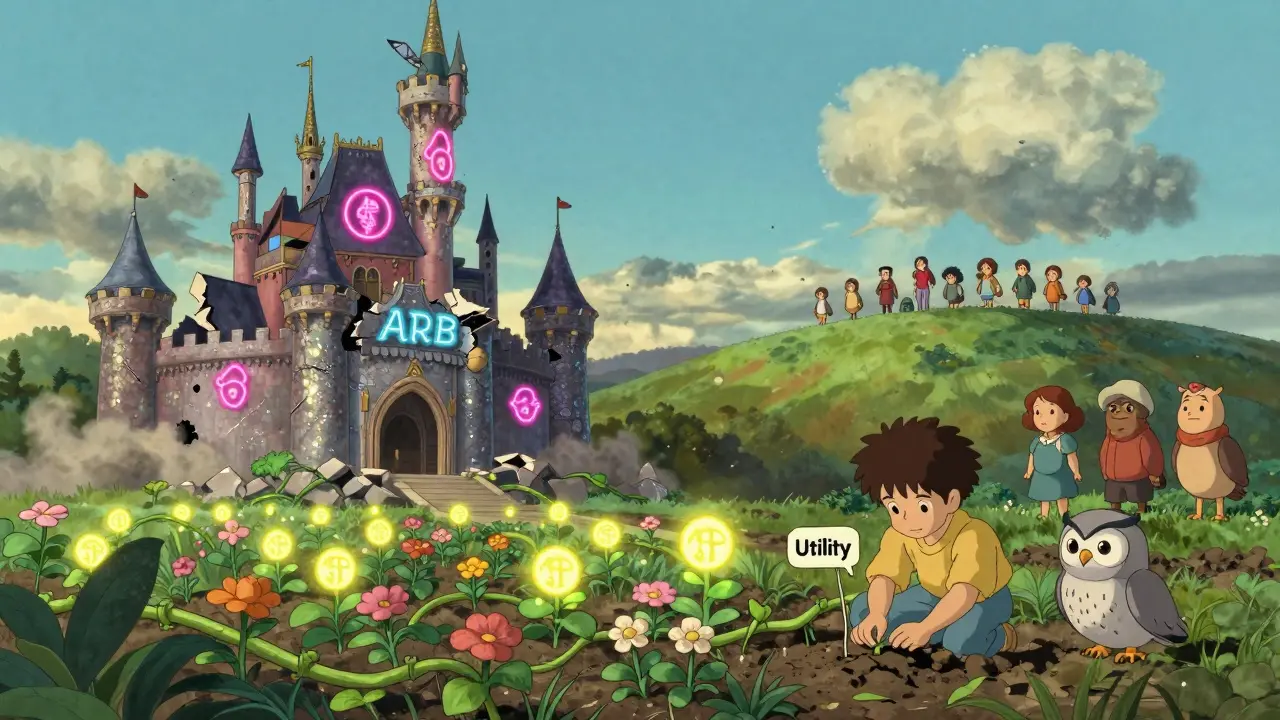
It looked like magic. Buy an NFT. Get rich. But the reality was uglier. Apecoin had no clear utility. No staking. No governance power. Just a token with a logo. Within a year, the hype faded. Marketing budgets burned $50 million on celebrity endorsements and metaverse parties. But no one used the token for anything real.
By December 2025, APE trades at $0.24. That’s a 99% drop from its peak. Twitter user @NFTInvestor87 summed it up: “I claimed 5,000 APE at $20. Watched it crash to $0.50 while the team spent millions on parties.”
This isn’t just a failure. It’s a warning. Airdrops built on hype, not utility, don’t last. They’re casino chips, not currency.

Hyperliquid: The Wildcard That Broke the Mold
In November 2024, Hyperliquid did something no one had done before. They didn’t track your activity. They didn’t ask for your wallet. They just launched. And they gave 31% of their 1 billion HYPE tokens directly to users who interacted with their platform - no claim portal, no forms, no waiting.
The result? HYPE launched at $2. Within 45 days, it hit $22.67. That’s a 1,033% gain. People who held onto it for even a week made life-changing money.
But here’s the twist: Hyperliquid didn’t stop there. They didn’t lock tokens. They didn’t do vesting. They just let the market decide. And it did - hard. By December 2025, HYPE settled at $8.45. Still, that’s over 300% from launch.
What made this different? It felt fair. No middlemen. No bots. No complex rules. Just open access. It was a statement: “We trust you to use this.” And for once, the market agreed.
Pi Network: The Six-Year Wait
Pi Network is the most controversial airdrop in history. Since 2019, over 50 million people downloaded the app and tapped a button every 24 hours to “mine” Pi. No hardware. No electricity. Just a phone and patience.
In February 2025, they finally launched the mainnet. Pi tokens were distributed. The team claimed a $12.6 billion valuation. But here’s the problem: you can’t actually trade Pi on most exchanges. Only 12% of users have moved their tokens to OKX or Binance. And when they do, Pi trades at $8 - nowhere near the $48 the team claims.
Trustpilot reviews are split. Some users call it “the best thing since Bitcoin.” Others say, “Six years of tapping a button for nothing.”
Is Pi real? Maybe. Is it valuable? Not yet. It’s less an airdrop and more a social experiment in mass adoption. And it’s still playing out.
Bonk: The Meme That Almost Killed Itself
Bonk dropped in December 2022 on Solana. It gave away 50 billion tokens - half to the community, half to early backers. At its peak, Bonk hit $0.000025. That made it worth over $1.3 billion.
But Bonk had no roadmap. No team. No utility. Just memes, influencers, and a community that loved chaos. The price crashed 99.99% by late 2025. Today, it trades at $0.0000000025.
And here’s the dark side: phishing scams. Over 22,000 wallets were drained by fake airdrop claim sites. People lost everything because they clicked a link that looked real. Bonk’s airdrop wasn’t just a flop - it was a lesson in how dangerous free crypto can be if you’re not careful.
What Really Makes an Airdrop Work?
Not all airdrops are created equal. The ones that last have three things:
- Real utility - Can you use the token? For swaps? For voting? For staking?
- Gradual release - Do tokens unlock over time? Or do people dump them the second they get them?
- Meaningful participation - Did you have to do something real to earn it? Or was it just a lottery?
Uniswap and Arbitrum nailed this. Apecoin and Bonk didn’t. Hyperliquid tried something new - and it worked, for now.
And then there’s regulation. The SEC has been cracking down. In 2024, they laid out rules: if your airdrop feels like a security offering, you need to register. That means no more “free tokens” that instantly trade on exchanges. Projects now have to prove users earned them through real activity.
How to Participate (Without Getting Scammed)
If you want to join the next big airdrop, here’s how to do it safely:
- Use a dedicated wallet - never your main exchange wallet.
- Only interact with official project websites. Double-check URLs. Airdrop scams look identical to real ones.
- Never pay gas fees to “claim” a token. Legit airdrops don’t ask for money upfront.
- Track your activity. Use tools like DeBank or Zapper to see if you’ve interacted with a protocol.
- Wait. Don’t sell immediately. Many top airdrops reward long-term holders.
And remember: if it sounds too good to be true, it is. That $500,000 airdrop you saw on TikTok? It’s probably a trap.
The Future of Airdrops
Airdrops are evolving. The next wave - called “airdrop 3.0” - will use AI to measure your contribution. Not just how many swaps you made, but how helpful you were. Did you report a bug? Did you write a guide? Did you help new users?
Projects like ENS already do this. They rewarded users who registered names early, not just those who held them.
And more protocols are adopting vesting schedules. Instead of giving you 10,000 tokens on day one, they’ll give you 1,000 per month for 10 months. That stops the dump.
The goal now isn’t to make people rich overnight. It’s to build communities that stick around. And that’s a lot harder - but a lot more valuable.
What was the first major crypto airdrop?
The first widely recognized crypto airdrop was Auroracoin in 2014, distributed to Icelandic citizens using national ID numbers. It was meant to create a national cryptocurrency and introduced the idea of giving free tokens to real people, not just early adopters.
Can you really make money from crypto airdrops?
Yes - but it’s rare. Uniswap and Arbitrum users turned small token amounts into life-changing sums. But most airdrops lose value fast. Only 22% of major airdrops since 2020 kept more than 15% of their peak value after one year. Success depends on utility, timing, and patience - not just claiming free tokens.
Are crypto airdrops legal?
It depends. In the U.S., the SEC considers many airdrops unregistered securities if they’re sold as investments. Projects now need to prove users earned tokens through real usage, not just holding. The EU’s MiCA law (2024) requires full transparency for distributions over €1 million. Legitimate airdrops are legal - but many aren’t.
Why do some airdrops fail so badly?
They’re built on hype, not utility. Apecoin and Bonk gave away tokens with no clear use case. People bought in for the price surge, not the tech. When the hype faded, so did the value. Also, many projects burn their treasury on marketing instead of building. Without real product, airdrops are just gambling.
How do I avoid airdrop scams?
Never pay fees to claim tokens. Never connect your main wallet to random websites. Only use official project links (check their Twitter or GitHub). Use tools like DeBank to verify eligibility. And never share your private key - no legitimate airdrop will ever ask for it.
Should I chase every airdrop I see?
No. Most airdrops are worthless. Focus on projects with real users, clear roadmaps, and active development. If a project has no GitHub commits, no Twitter replies, and no TVL, skip it. Time spent farming useless tokens is time lost.






Amit Kumar
December 21, 2025 AT 20:11Man, I remember when Auroracoin dropped. Icelanders were literally using it to buy coffee and fish. Now? Half of them forgot they even had it. But hey - at least it proved you could give crypto to regular people and not just degens.
Dan Dellechiaie
December 22, 2025 AT 00:13Uniswap’s airdrop was the only one that didn’t feel like a pyramid scheme. Everyone else just slapped a token on a community and ran. Arbitrum? Solid. Apecoin? A marketing budget with a wallet address.
Sophia Wade
December 23, 2025 AT 16:29There’s a quiet tragedy in how we treat airdrops now - we don’t see them as experiments in governance or community, but as lottery tickets. We’ve turned trust into transaction. And in doing so, we’ve lost the soul of what decentralized finance was supposed to be.
Charles Freitas
December 24, 2025 AT 00:29People still think Hyperliquid was fair? Bro, they had 3000 bots running wallets before launch. The whole thing was a liquidity pump dressed up as a revolution. Don’t be fooled by the lack of a claim portal - that’s just the new way to hide the rug.
Tristan Bertles
December 24, 2025 AT 09:30True story - I claimed 400 UNI back in 2020. Didn’t sell a single one. Staked it, reinvested the rewards, added more liquidity. Now it’s worth more than my first car. Airdrops aren’t free money. They’re free *opportunity*. You just gotta treat them like a business, not a binge.
Rachel McDonald
December 24, 2025 AT 23:25PI NETWORK IS A SCAM. I tapped for 6 years. Got 1200 Pi. Tried to sell on OKX. Got $8. The team’s still posting memes about ‘revolution’. Meanwhile, my rent’s due. 😔
Jayakanth Kesan
December 26, 2025 AT 16:25Love how Bonk turned into a phishing magnet. People click links like they’re opening spam emails from 2007. If you’re not using a burner wallet for airdrops, you’re just handing your keys to a stranger on the internet.
Rishav Ranjan
December 27, 2025 AT 00:51Airdrops are dead. Next thing we’ll get NFT-based tax audits.
Jake Mepham
December 28, 2025 AT 04:50If you want to win the next big airdrop, stop chasing hype. Start using DeFi like a tool, not a casino. Swap on Uniswap. Bridge on Arbitrum. Test new dApps. Document your activity. The tokens follow the work - not the FOMO.
Jacob Lawrenson
December 28, 2025 AT 13:52Hyperliquid’s move was genius. No forms. No waiting. Just drop it and let the market breathe. Most projects treat users like criminals. They treated them like adults. That’s why it worked.
Sheila Ayu
December 30, 2025 AT 12:43Why do people still believe in Apecoin? Yuga Labs spent $50M on parties and zero on tech. They didn’t build a token - they built a party invite. And now the club’s closed. 🚫
Janet Combs
December 31, 2025 AT 09:15i tried to claim arb but i got confused with the steps and gave up… then i saw someone made 7k from it… now i feel like a dumbass. but hey, at least i didn’t lose money on a scam site lol
Ashley Lewis
January 1, 2026 AT 22:30Regulatory compliance is not a suggestion. If your airdrop doesn’t pass the Howey Test, it’s not a gift - it’s a felony. The SEC isn’t here to ruin your fun. They’re here because people lost their life savings to tokens with no code, no team, and no purpose.
Shubham Singh
January 2, 2026 AT 21:00Let’s be honest - 90% of airdrop participants don’t understand what a smart contract is. They see ‘free tokens’ and think ‘free money’. That’s not innovation. That’s capitalism with a blockchain sticker.
Ellen Sales
January 4, 2026 AT 08:51the fact that people still talk about auroracoin like it was some kind of prophet… i mean, it was literally a government experiment that failed. but sure, lets romanticize it. 🤷♀️
Earlene Dollie
January 5, 2026 AT 18:28I cried when my 5000 APE dropped to $0.50. I spent months holding it, thinking the BAYC brand would save it. Turns out, a monkey picture doesn’t make a currency. I’ve since learned: brand ≠ utility.
Steve B
January 6, 2026 AT 22:30One cannot help but observe the metaphysical paradox of the airdrop: it is simultaneously an act of generosity and an act of control. The token is given freely, yet its value is determined by the very mechanisms of capital that it claims to oppose.
Vijay n
January 8, 2026 AT 17:31pi network is a psyop by the fed to track crypto users. the app collects your contacts, location, and voice data. they’re not selling pi - they’re selling you. dont fall for it
Jordan Renaud
January 8, 2026 AT 19:21What’s fascinating isn’t who made money - it’s who stayed. The people who held UNI, who kept using Arbitrum, who didn’t cash out at $10 - they’re the ones building the future. Airdrops don’t make communities. Sustained participation does.
Luke Steven
January 9, 2026 AT 14:31Real talk: the best airdrop I ever got was a bug bounty from a small DeFi protocol. I found a reentrancy flaw. Got $20k. No token. No hype. Just clean code and a thank you. That’s the future - reward contribution, not speculation.
Brian Martitsch
January 10, 2026 AT 08:04Only degens think Bonk was a real project. A token with no team, no whitepaper, no roadmap? That’s not innovation - that’s a joke with gas fees.
Aaron Heaps
January 11, 2026 AT 19:44Uniswap’s 17% retention? That’s a miracle. Most tokens die in 90 days. You’re not seeing the 10,000 other airdrops that vanished into dust.
SHEFFIN ANTONY
January 13, 2026 AT 19:38Everyone’s acting like Hyperliquid was fair. But guess what? The top 10 wallets got 60% of the tokens. The rest of us got crumbs. It’s not open access - it’s just better marketing.
Sarah Glaser
January 14, 2026 AT 08:20Just claimed my first airdrop in 2025. It was a 0.0001 ETH reward for using a new DEX. Took 3 days. Worth $0.42. Still feels better than any lottery ticket.