17
QuickSwap v3 (Polygon zkEVM) Review: Fees, Liquidity & Safety in 2026

Swapping tokens on Ethereum mainnet can cost more than a coffee, but doing it on Polygon zkEVM is practically pennies. That’s why traders are looking at QuickSwap v3, the Polygon-native decentralized exchange deployed on this zero-knowledge rollup. But does it actually deliver? Is the liquidity deep enough for your trades, and is the tech safe enough to trust with your funds?
This isn't just another copy-paste of the Uniswap v3 model. While QuickSwap v3 borrows heavily from the Uniswap codebase, its presence on Polygon zkEVM changes the game for gas costs and speed. However, "fast" doesn't always mean "liquid." In this review, we break down the real-world performance, fee structures, and risks you need to know before you bridge your assets.
The Core Tech: What Makes QuickSwap v3 Different?
QuickSwap launched in early 2021 as a fork of Uniswap v2, but the v3 upgrade brought a major shift: concentrated liquidity. This means liquidity providers (LPs) don’t have to spread their capital across all possible prices. Instead, they pick a specific price range where they expect trading to happen. If the price stays in that range, your capital works harder, and you earn more fees. If it moves out, your position becomes inactive until the price returns.
On Polygon zkEVM, this model runs on top of a zero-knowledge proof system. Unlike traditional sidechains, zkEVM posts compressed data to Ethereum mainnet, meaning you get Ethereum-level security without the high fees. The smart contracts are non-custodial, so your funds stay in your wallet until you explicitly approve a transaction. There’s no middleman holding your keys.
- Concentrated Liquidity: Boosts capital efficiency by up to 4,000x compared to v2 models.
- Zero-Knowledge Proofs: Ensure data integrity and security backed by Ethereum.
- EVM Equivalence: You can use standard tools like MetaMask and Hardhat without special adapters.
Fees and Tokenomics: Where Does Your Money Go?
Cost is the primary draw for using QuickSwap on zkEVM. The platform charges a swap fee based on the volatility of the token pair. Standard tiers include 0.05%, 0.30%, and 1.00%. For most stablecoin pairs or blue-chip assets, the 0.05% tier is common. Add to that the gas fee, which on Polygon zkEVM typically hovers under $0.10 per transaction, and you’re looking at some of the lowest total costs in DeFi.
But who gets paid? The fee distribution is transparent and favors LPs. Here’s the breakdown for every swap executed on the platform:
| Recipient | Percentage of Swap Fee | Purpose |
|---|---|---|
| Liquidity Providers | 90% | Rewards for providing capital in pools |
| Dragon’s Lair Stakers | 6.8% | Rewards for staking QUICK token |
| QuickSwap Foundation | 1.7% | Protocol development and maintenance |
| v3 Developers | 1.5% | Incentives for code contributors |
The QUICK token plays a central role here. It’s not just a governance token; it’s used for staking in Dragon’s Lair to earn a share of protocol revenue. If you’re thinking about long-term involvement, holding and staking QUICK gives you direct exposure to the protocol's success.
Liquidity Reality Check: Volume vs. Depth
Here’s where the rubber meets the road. QuickSwap is a giant on Polygon PoS, handling millions in daily volume. But on Polygon zkEVM, the picture is different. Recent data shows total liquidity on the zkEVM deployment hovering around $85,000 to $100,000, with 24-hour volumes often in the low thousands.
Does this matter? Absolutely. If you’re swapping $50 worth of USDC for MATIC, you won’t notice a thing. The slippage will be negligible. But if you’re trying to move $10,000, you might eat into the available liquidity, causing your execution price to drift significantly from the quoted price. This is known as price impact.
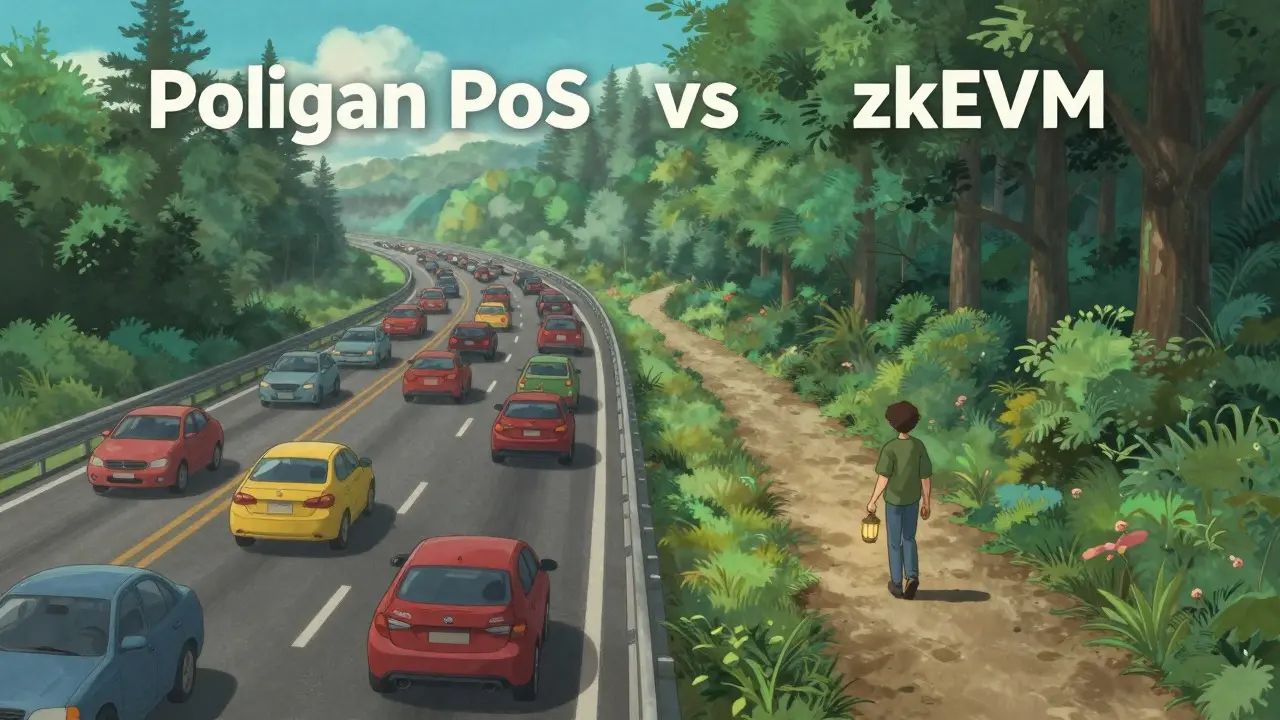
For large trades, it’s still safer to use QuickSwap on Polygon PoS or even centralized exchanges. The zkEVM version is best suited for small-to-medium swaps, testing new integrations, or users who specifically want to interact with zk-rollup technology. Think of it as a niche venue rather than the main highway.

User Experience: Onboarding and Usability
If you’ve used Uniswap, you already know how to use QuickSwap. The interface is nearly identical, featuring a clean swap page, pool management dashboard, and farming options. The main difference is the network selector. You’ll need to ensure your wallet is connected to Polygon zkEVM, not Polygon PoS. One wrong click, and you’ll be sending transactions to the wrong chain.
Getting started takes about 30 minutes if you’re new to Web3:
- Set up a wallet: Use MetaMask, Rabby, or Trust Wallet.
- Add the network: Configure RPC settings for Polygon zkEVM (often pre-loaded in newer wallets).
- Bridge assets: Transfer ETH or other tokens from Ethereum or Polygon PoS to zkEVM using official bridges.
- Connect and swap: Visit quickswap.exchange, select the zkEVM network, and execute your trade.
The biggest friction point is bridging. Moving assets between chains adds time and complexity. Make sure you have enough ETH on zkEVM for gas fees, as you can’t pay gas in MATIC on this specific network.
Security Risks and Limitations
QuickSwap v3 uses audited, battle-tested code derived from Uniswap v3. The risk of a core protocol exploit is low, especially given the extensive usage of these contracts across multiple chains. However, "low risk" isn't "zero risk."
Your main vulnerabilities are:
- Smart Contract Risk: Even audited code can have bugs. Always check contract addresses against official sources.
- Rollup Dependency: Polygon zkEVM relies on zero-knowledge proofs and Ethereum for finality. A bug in the rollup layer could affect all apps on it.
- Phishing and Fake Tokens: Since anyone can deploy a token, you might see fake versions of popular assets. Always verify token symbols and contract hashes.
- No Customer Support: Lost seed phrase? Wrong address? No one is coming to save you. Self-custody means full responsibility.
For peace of mind, start with small amounts. Test the process with a trivial swap before committing significant capital.
How It Compares: QuickSwap vs. Alternatives
You have options on Polygon zkEVM. Uniswap v3 is also deployed there, offering similar functionality but with a larger global user base. SushiSwap provides an alternative AMM model with its own token incentives. So, why choose QuickSwap?
QuickSwap wins on ecosystem integration. It’s part of the DragonFi suite, which includes perpetual futures and gaming integrations. If you’re already in the Polygon ecosystem, staying within QuickSwap keeps your assets local and reduces bridging needs. Compared to centralized exchanges, QuickSwap offers self-custody and permissionless access, but at the cost of higher complexity and lower liquidity for exotic pairs.
For pure speed and low fees, both QuickSwap and Uniswap on zkEVM are excellent. The choice often comes down to which token pairs you trade most frequently and which incentive programs appeal to you.
Final Verdict: Who Should Use QuickSwap v3 on zkEVM?
QuickSwap v3 on Polygon zkEVM is a solid, technically sound option for traders who want low-cost access to DeFi on a next-generation rollup. It’s perfect for small-to-medium swaps, users comfortable with Web3 wallets, and those interested in the broader DragonFi ecosystem.
However, it’s not the right tool for everyone. If you’re moving large sums, stick to deeper liquidity venues. If you’re brand new to crypto, the learning curve of bridging and self-custody might be overwhelming. But if you’re ready to dive in, QuickSwap offers a reliable, efficient, and secure way to participate in the growing zkEVM landscape.
Is QuickSwap v3 on Polygon zkEVM safe to use?
Yes, it uses audited Uniswap v3-derived contracts and runs on the secure Polygon zkEVM rollup. However, as with any DeFi protocol, you face smart contract risk and must manage your own wallet security. Start with small amounts to test the waters.
What are the gas fees on QuickSwap zkEVM?
Gas fees are extremely low, typically under $0.10 per transaction. You pay gas in ETH, not MATIC, because zkEVM is an Ethereum-compatible rollup. The total cost of a swap is the AMM fee (e.g., 0.05%) plus this minimal gas cost.
Can I use QuickSwap zkEVM for large trades?
It’s not recommended for very large trades due to limited liquidity depth. Current TVL is relatively low compared to Polygon PoS, so large orders may suffer from high price impact. For big moves, consider QuickSwap on Polygon PoS or centralized exchanges.
How do I get tokens onto Polygon zkEVM?
You need to bridge assets from Ethereum Mainnet or Polygon PoS to Polygon zkEVM. Use official Polygon bridges or reputable third-party aggregators. Ensure you have some ETH on the zkEVM network for gas fees before bridging other tokens.
What is the difference between QuickSwap v2 and v3?
V3 introduces concentrated liquidity, allowing LPs to specify a price range for their capital. This makes capital more efficient and increases potential rewards for LPs. V2 spreads liquidity across all prices, which is less efficient but simpler to manage.






Susan Kiley
August 18, 2026 AT 17:26Oh, how quaint. Another attempt to shoehorn a bloated L1 into a rollup that barely has the bandwidth to breathe. The liquidity metrics are a joke, truly. One expects a certain standard of sophistication from the 'elite' DeFi crowd, yet here we are, staring at an $85k TVL like it's a Michelin star. How daring of them to call this a 'main highway' when it's more of a dirt path in a swamp. :P
Darren Moon
August 19, 2026 AT 19:01One must observe the profound inefficiency inherent in the current liquidity provision mechanisms. The concentrated liquidity model, while theoretically superior in capital efficiency, suffers from a significant lack of depth on this specific zkEVM deployment. It is rather tedious to witness such undercapitalized pools attempting to service even modest trading volumes. The infrastructure remains, in my estimation, somewhat immature for serious institutional engagement.
Quang Thai Tran
August 21, 2026 AT 14:31Do not be fooled by the 'zero-knowledge' marketing speak. This is merely another layer of opacity designed to obscure the true custodial nature of these bridges. The proof system is only as strong as its weakest verifier, and we all know who controls those keys in the shadows. Stay vigilant. The matrix is watching your wallet balances.
Dianne Ritter
August 23, 2026 AT 01:44I actually think this is a really interesting development. It’s cool to see the ecosystem expanding beyond just Polygon PoS. I’ve been waiting for zkEVM to mature enough for everyday use, so seeing QuickSwap there is a good sign. The fees are definitely attractive for small trades.
Calliope Clio
August 25, 2026 AT 01:36Ugh, the gas fees are low but the slippage? 😩 It’s like trying to drink through a straw during a hurricane. If you’re moving anything over $500, you’re basically donating to the protocol developers. Just stick to Uniswap v3 on Arbitrum if you want actual liquidity. This feels like a beta test disguised as a launch. 🙄
Abigail Sparks
August 25, 2026 AT 13:40LISTEN UP! If you are still paying $5 in gas on Ethereum mainnet for a swap, you are doing it WRONG. QuickSwap on zkEVM is the future. The tech is solid. The fees are pennies. Stop being afraid of new chains and start experimenting. The early adopters win the game. Go bridge some ETH and test it out today!
Mike Baca
August 25, 2026 AT 21:23it makes me think about the nature of decentralization itself... is it real if the liquidity is so thin? i mean sure the code is audited but the market is what matters. its kinda wild how we trust math more than people sometimes. maybe thats why its safer? or maybe its just a different kind of risk. i dont know man. but the fees are nice tho.
Leah Humphrey
August 27, 2026 AT 05:24The capital efficiency metrics cited are misleading without context regarding the active range utilization. In practice, the effective liquidity per price tick is significantly lower than the headline TVL suggests due to the narrow ranges selected by LPs. This creates a fragmented order book that is highly susceptible to arbitrage sniping.
Jennifer Ulmer
August 27, 2026 AT 23:08I agree with the point about bridging. It is the hardest part for most people. Once you get the tokens over, the interface is very easy to use. It looks just like Uniswap which is nice because you don't have to learn a new layout. I think it will get better as more people move their assets over time.
Jade Brown
August 28, 2026 AT 13:08Let's cut the fluff and look at the raw data. The spread between bid and ask on major pairs is widening faster than the fee tier can compensate for. You're not saving money; you're bleeding alpha. The 'Dragon's Lair' staking mechanism is a classic yield trap, incentivizing stagnation rather than flow. Smart money knows where to go. Are you smart? Or are you just a bag holder for the narrative?
Stephanie Millar
August 29, 2026 AT 06:24It is fascinating, indeed!, to see how the technology evolves across different ecosystems. From a cultural perspective, the adoption rate varies wildly depending on the region. In the UK, we tend to be quite cautious with new financial instruments, so the safety aspect mentioned in the review is particularly relevant to us. However, the speed is undeniably impressive, isn't it?! It changes the dynamic of trading entirely, doesn't it??
Nikki keller
August 29, 2026 AT 08:24There is a philosophical tension here between the promise of infinite scalability and the reality of finite human attention. We build these sophisticated layers, yet the user experience often remains a source of friction. Perhaps the solution isn't just technical, but educational. We need to respect the user's time and cognitive load. If the bridge is too complex, the best DEX in the world is useless to the average person.
miranda gamboa
August 31, 2026 AT 01:03Great breakdown! One thing I’d add is the importance of monitoring the sequencer health. Since zkEVM relies on a centralized prover initially, any downtime there affects finality times. Keep an eye on the block explorer for pending transactions. Also, the tokenomics of QUICK seem sustainable if volume grows, but watch out for inflationary emissions. Stay informed, folks!
Kiran Jayaram
August 31, 2026 AT 16:08this is all fake news anyway the real liquidity is on solana and everyone knows it polygon is dying slowly and quickswap is just a zombie app nobody uses anymore why bother reading this long article when you could just check the volume chart and see its flatlined? stop wasting our time with these recycled uniswap forks
Uday N M
September 2, 2026 AT 07:15Polygon is Indian technology. We should support it. The fees are low for our traders. Good work.
Melissa G
September 2, 2026 AT 13:58The distinction between 'fast' and 'liquid' is crucial and often overlooked in these reviews. Speed is a feature of the execution layer, whereas liquidity is a function of market participation. Conflating the two leads to poor decision-making for traders. One must understand that a fast chain with no participants is merely a high-speed empty room. The value lies in the interaction, not the velocity.
Claudio Perrone
September 3, 2026 AT 04:15so basically its just uniswap but cheaper right? i always thought zk was magic but now im confused. is it safe? my cousin lost his money on a rug pull last week. is this one of those rugs? please tell me its safe before i put my rent money in. also why do i need eth for gas and not matic? that seems wrong. am i missing something big here?
Aaron Morrissey
September 3, 2026 AT 15:19A most compelling analysis, though one might argue that the term 'solid' understates the architectural elegance of the zk-rollup integration. The synergy between concentrated liquidity and zero-knowledge proofs represents a paradigm shift in decentralized finance. It is not merely an improvement; it is a reimagining of the exchange paradigm itself. Bravo to the developers for navigating such complex cryptographic challenges.
Sarah Campbell
September 4, 2026 AT 11:18AMERICA FIRST! Why are we using foreign tech? Polygon is backed by VC money from everywhere. We should build our own US-based L2. But okay, the fees are low so I guess I'll try it. Don't let the crypto communists take over our wallets! 🇺🇸🚀💎
Ami Elizabeth
September 5, 2026 AT 18:38honestly just swapped some usdc for dai yesterday and it took like 2 seconds. felt smooth. didnt notice any weird slippage either. gonna keep an eye on it for a few days but so far so good. nice write up btw.
michelle aguilar
September 7, 2026 AT 15:03You simply must consider the emotional toll of managing multiple bridges, don't you? It is exhausting, isn't it? To constantly verify addresses and worry about contract hashes? I find it personally draining. Perhaps we should all just wait for a unified standard before committing further capital? It would save us all so much heartache, wouldn't it?
Lance Konig
September 8, 2026 AT 19:55The review misses a critical nuance regarding the validator set. While the contracts are audited, the security model depends heavily on the honesty of the provers. A 51% attack on the prover set is theoretically possible if decentralization lags behind adoption. This is a non-trivial risk factor that deserves more weight in the final verdict. Do not underestimate the centralization vector.