27
OFAC Cryptocurrency Sanctions: A Practical Compliance Guide for 2026

Imagine waking up to a news alert that your company’s wallet address has just been added to the U.S. government’s blacklist. No warning. No intent required. Just strict liability and a potential penalty that could wipe out years of profit. For many in the crypto space, this isn’t a hypothetical scenario; it is the daily reality of navigating OFAC cryptocurrency sanctions, a regulatory framework that has evolved from vague guidelines to an aggressive enforcement machine.
You might think that because blockchain is decentralized, you can hide behind pseudonymity. But the Office of Foreign Assets Control (OFAC) sees it differently. Since formalizing its guidance in 2021, OFAC has made it clear: if you touch U.S. dollars or involve U.S. persons, the rules apply with full force. Whether you run a massive exchange like Coinbase or a small DeFi protocol, the expectation is now concrete, technical, and unforgiving.
What Exactly Does OFAC Regulate in Crypto?
To understand the risk, you first need to know who is pulling the strings. The Office of Foreign Assets Control is a division of the U.S. Department of the Treasury established in 1950. Its job is to enforce economic and trade sanctions based on foreign policy and national security goals. While it started with traditional finance, its reach extended into digital assets when it began sanctioning specific wallet addresses back in 2018.
The turning point came in October 2021 with the publication of the 'Sanctions Compliance Guidance for the Virtual Currency Industry.' This document removed all ambiguity. It confirmed that OFAC regulations apply to all activities involving digital assets, including those conducted by U.S. persons, entities organized under U.S. laws, and anyone physically located in the United States. There is no "crypto exception." If a transaction involves a sanctioned entity, it is prohibited, regardless of whether the counterparty is identified by a name or a string of hexadecimal characters.
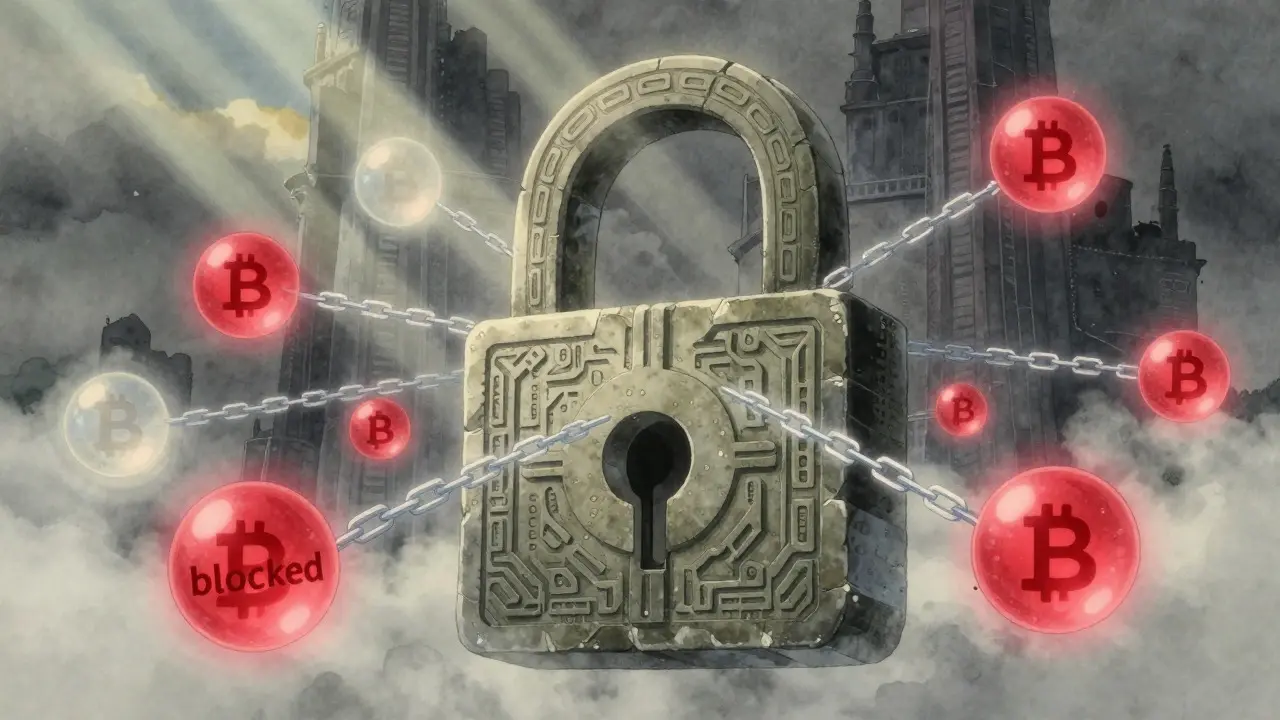
The core mechanism here is the Specially Designated Nationals (SDN) List. As of late 2025, this list contains over 27,500 entries, including more than 1,247 specific cryptocurrency addresses. These aren't just names; they are technical identifiers. If your system detects a transaction flowing to one of these addresses, the asset must be blocked immediately. Failure to do so doesn't require proof of intent. Under strict liability principles, even an accidental oversight due to poor software integration can result in significant penalties.
The Strict Liability Trap: Why Intent Doesn't Matter
This is where most companies get tripped up. In traditional law, "good faith" often helps. In OFAC compliance, it rarely does. The framework operates on strict liability, meaning violations occur without intent or knowledge. You don't have to *know* you were dealing with a sanctioned party; you just have to fail to use reasonable measures to find out.
Consider the September 2025 settlement with ShapeShift AG. The company paid $750,000 not because they deliberately tried to evade sanctions, but because they allowed users in Cuba, Iran, Sudan, and Syria to exchange approximately $12.5 million in cryptocurrency over two years. Their defense? They didn't have geolocation controls. OFAC didn't care. The lack of basic screening tools was enough to establish liability. This case serves as a stark reminder: in crypto compliance, ignorance is not just bliss; it's expensive.
Another recent example is the re-designation of Garantex Europe OU in August 2025. This action targeted not just the exchange but its successor, executives, and supporting companies across Russia and the Kyrgyz Republic. OFAC is increasingly using "network sanctions," pursuing entire ecosystems rather than single nodes. If you rely on third-party infrastructure that supports sanctioned operations, you are exposed. The message from regulators is clear: map your supply chain, or pay the price.
Technical Implementation: How to Block Digital Assets
So, what does actual compliance look like on the backend? It’s not just about checking names against a list. It requires specific technical procedures outlined in OFAC FAQ 646. When an institution holds digital assets that must be blocked, it has two main options:
- Individual Wallet Blocking: Freeze each specific wallet associated with a blocked person. This is precise but administratively heavy if you have many small holders.
- Consolidated Blocked Wallets: Move all blocked assets into a single designated wallet titled 'Blocked SDN Digital Currency.' This simplifies accounting but requires robust internal controls to ensure these assets remain frozen until legal prohibitions end.
Crucially, OFAC explicitly states that holders of blocked digital currency are not obligated to convert these assets into fiat currency. You can keep them in their digital form. However, you must submit detailed reports to OFAC regarding these blocked assets, with requirements varying based on asset type and value.
To execute this, you need real-time screening. Manual checks are impossible at scale. You need blockchain analytics tools that integrate with your transaction monitoring systems. These tools screen every incoming and outgoing transaction against current sanction lists. The market leaders in this space include Chainalysis, Elliptic, and TRM Labs. These platforms maintain updated databases of sanctioned addresses and offer APIs that can flag suspicious activity in milliseconds.
| Tool | Documentation Rating (G2) | Key Strength | Best For |
|---|---|---|---|
| Chainalysis Reactor | 4.7/5 | Custom risk rules, low false positives | Large exchanges, enterprise compliance |
| TRM Labs | 3.2/5 | Cost-effective, good for mid-size firms | Startups, smaller exchanges |
| Elliptic | 4.5/5 | Strong privacy coin tracking capabilities | Firms handling Monero/Zcash |
The Five Pillars of a Compliant Program
Buying software is only half the battle. OFAC expects a holistic Sanctions Compliance Program (SCP). According to their guidance, five components are non-negotiable:
- Management Commitment: Documented board-level oversight. The CEO and CFO must sign off on compliance budgets and policies. It can't be an IT project; it has to be a business priority.
- Risk Assessment: Updated quarterly. You need a documented methodology for assessing which parts of your business carry the highest sanctions risk. Are you dealing with high-risk jurisdictions? Do you support privacy coins?
- Internal Controls: Automated screening tools integrated at onboarding, transaction processing, and periodic portfolio reviews. Relying solely on initial customer screening is a common pitfall flagged by experts like David Stetson from Steptoe & Johnson LLP.
- Testing and Auditing: Conducted by independent third parties annually. Internal audits are fine for day-to-day, but you need external validation to prove to regulators that your systems work.
- Training: Mandatory for all relevant staff. The Association of Certified Anti-Money Laundering Specialists (ACAMS) found that compliance officers need an average of 147 hours of specialized training to effectively implement crypto sanction controls. Aim for 92% completion rates among staff.
Implementation takes time. A 2025 study suggests a full rollout-from risk assessment to staff training-takes 22 to 36 weeks. Don't expect to flip a switch and be compliant overnight. Budget for 6-9 months of dedicated effort.
Challenges in Decentralized Finance (DeFi)
If you operate in centralized exchanges, the path is relatively clear. But what about DeFi? Here, the challenges spike. In decentralized protocols, transaction counterparties are often unknown. Liquidity pools and automated market makers make it hard to trace where funds ultimately end up.
Seventy-three percent of surveyed firms report difficulties applying traditional sanctions screening to DeFi protocols. Professor Sarah Bloom Raskin, former Deputy Treasury Secretary, argued in a 2025 Harvard Law Review article that OFAC's strict liability approach creates "impossible compliance burdens" for entities with no control over transaction routing. She has a point. How do you screen a smart contract interaction where the counterparty is a pool of anonymous liquidity providers?
Yet, OFAC hasn't blinked. Their October 2025 update to FAQ 646 clarified that you must take "reasonable measures to prevent transactions involving blocked persons" even when counterparty identification is technically challenging. This means you need to assess the risk of the protocol itself. If a DEX allows easy access to sanctioned wallets, your exposure increases. Some experts suggest using "whitelisting" strategies or integrating with oracle networks that provide sanitized data, though this remains an evolving area.

Costs and Resource Allocation
Compliance is expensive. According to a 2025 Deloitte survey of 78 cryptocurrency firms, annual implementation costs range from $150,000 to $2 million, depending on transaction volume. A Kraken compliance manager noted that while implementing Chainalysis Reactor dropped their false positive rate from 18% to 4.3%, the cost was $450,000. Is it worth it? Compared to a $750,000 penalty plus reputational damage, most say yes.
Beyond software, you need people. Certified Blockchain Intelligence Analysts (BIA) command salaries 35% higher than standard compliance roles. You also need to account for maintenance. One Reddit thread from r/CryptoCompliance documented that ongoing maintenance requires 1.7 full-time employees per $100 million in daily transaction volume. If you're a smaller player, consider outsourcing to specialized vendors, but retain ownership of the strategy.
Gartner projects the crypto sanction compliance sector will reach $1.8 billion by 2026, growing at 34% annually. This growth reflects both regulatory pressure and technological maturity. The days of flying under the radar are over. The question is no longer *if* you should comply, but *how efficiently* you can do it.
Future Trends and Regulatory Outlook
Where is this heading? OFAC Director Andrew E. Hallman announced a new 'Digital Asset Sanctions Task Force' in September 2025, comprising 35 specialists dedicated solely to crypto enforcement. The Treasury Department’s 2026 budget request includes $28 million specifically for cryptocurrency sanction enforcement, a 40% increase from 2025. This signals sustained, if not intensified, focus.
Technologically, we may see sanction screening move on-chain. The Ethereum Foundation announced EIP-7594 in September 2025, proposing on-chain sanction compliance mechanisms. This would allow protocols to automatically block known bad actors at the code level. However, this faces community resistance, with over 1,200 comments on developer forums condemning the proposal as censorship. The debate is fierce, but the trend toward deeper integration is undeniable.
Forrester predicts that by 2027, 65% of cryptocurrency transactions will undergo real-time sanction screening, up from 38% in 2025. Former Treasury Secretary Janet Yellen predicted in July 2025 that sanction evasion through cryptocurrency will decline by 60% over the next five years due to improved frameworks. While skeptics warn of ecosystem fragmentation, the direction is clear: transparency is becoming the default, not the exception.
Practical Next Steps for Your Business
If you’re reading this and realizing your compliance program is lacking, start here:
- Audit Your Current State: Do you have automated screening? If not, you are exposed. Map your current transaction flows and identify gaps.
- Select the Right Tool: Don't just buy the most famous tool. Test them against your specific use case. If you handle privacy coins, prioritize tools with strong de-anonymization capabilities.
- Update Your Risk Assessment: Include DeFi exposure, jurisdictional risks, and counterparty types. Update this quarterly.
- Train Your Team: Invest in BIA certifications for key staff. Ensure everyone understands the difference between a false positive and a missed sanction.
- Document Everything: Keep records of every screening decision, every blocked asset, and every training session. In a dispute, documentation is your shield.
Compliance isn't a one-time checkbox. It's an ongoing operational discipline. But done right, it protects your license to operate in the world's largest financial markets. The alternative? A surprise letter from the Treasury Department and a headline you won't want to read.
Does OFAC regulate stablecoins?
Yes. Stablecoins are treated as digital assets. If a stablecoin transaction involves a sanctioned entity or a U.S. person, OFAC rules apply. Many issuers now build compliance directly into their smart contracts to facilitate screening.
What happens if I accidentally transact with a sanctioned wallet?
You face strict liability. You must block the assets immediately and report them to OFAC. Penalties depend on the severity and whether you had a reasonable compliance program in place. Having a robust SCP can mitigate fines, but it doesn't eliminate liability.
How often should I update my SDN list database?
Daily. OFAC adds new crypto addresses frequently-37 new ones were added in Q2 2025 alone. Most blockchain analytics tools offer API integrations that sync updates automatically. Manual updates are too slow and error-prone.
Is compliance different for DeFi vs. CeFi?
Yes. CeFi (Centralized Finance) has clear points of control (onboarding, withdrawal). DeFi is harder because counterparties are often anonymous. In DeFi, you must assess the risk of the protocol itself and use "reasonable measures" like whitelist-only interfaces or oracle-based screening, though this is still an evolving best practice.
What is the average cost of setting up OFAC compliance?
It varies widely. Small firms might spend $150,000 annually on tools and staff. Large enterprises can spend up to $2 million. Initial setup typically takes 22-36 weeks, including software integration, risk assessment, and staff training.